Friday, December 5, 2014

Minaret of Prophet Isa (upon him be peace)


Minaret of Isa as
The minaret viewed from the rear of the Umayyad Mosque – Photo: R.Chohan
This minaret, which is on the left side of the Umayyad Mosque is also known as the Jesus minaret. It is from here that Hazrat Isa (upon him be peace) will descend back to earth towards the end of time.
  • Muslims believe that Isa (upon him be peace) did not die on the cross but Allah (Glorified and Exalted is He) raised him to heaven and he will return one day to defeat the Dajjal (Anti-Christ). According to a Hadith, he is on the second heaven. The Prophet (peace and blessings of Allah be on him) mentioned, “During the Me’raj (Ascension), I met Isa (upon him be peace) on the second heaven. I found him of medium stature, reddish white. His body was so clean and clear, that it appeared as though he had just performed ghusal (ablution, cleansing of the entire body) and come.”
  • In another Hadith, the Prophet (peace and blessings of Allah be on him) mentioned, “Allah will send Maseeh ibne Maryam (Messiah son of Mary). Thus he will descend near the white eastern minaret of Damascus, clad in two yellow sheets, leaning on the shoulders of two angels.” [Sahih Muslim]
Aerial view of the Umayyad Mosque
Aerial view of the Umayyad Mosque – Photo: akg-images.de
  • The physical features of Isa (upon him be peace): He will resemble the famous sahabi Urwa bin Masoodi (may Allah be pleased with him). He will be of average height and red and white in colour. His hair will be spread to the shoulders, straight, neat and shining as after a bath. On bending his head, it will seem as if pearls are falling. He will have armour on his body. He will be wearing two pieces of cloth light yellow in colour.
  • He will descend on a Jamaat (group) that will be righteous at the time and comprising of 800 men and 400 women. The people will be preparing for war at the time against Dajjal. It will be time for Fajr prayers, and Imam Mahdi will be the Amir (leader) of the Muslims. From the darkness of the dawn, a sound will suddenly be heard that “one who listens to your pleas has come” – the righteous people will look everywhere and their eyes will fall on Isa (upon him be peace). Briefly, at the time of Fajr, Isa (upon him be peace) will descend. When descending, Isa (upon him be peace)’s hands will be on the shoulders of two angels (according to another source (Kab Abrar), a cloud will carry him). On their insistence Isa (upon him be peace) will introduce himself. He will inquire about their enthusiasm and thoughts on Jihad against Dajjal. Isa (upon him be peace) will descend on the eastern side near the minaret in Damascus (or in Baitul-Muqaddus according to another narration). At the time Imam Mahdi will have proceeded forward to lead the Fajr Salaat. The Iqamat of the Salaat will already have been recited and Imam Mahdi will call Isa (upon him be peace) for Imamat (to lead the prayer), but he (Isa (upon him be peace)) will instead tell Imam Mahdi to lead the prayer since the Iqamat of that Salaat has already been said for him. Thus Imam Mahdi will lead the prayer, and Isa (upon him be peace) will follow him. After the ruku, he will make this statement: “Allah has killed Dajjal and the Muslims have appeared.”
  • Isa (upon him be peace) will subsequently kill Dajjal and a great era of peace and harmony will come to the world. Isa (upon him be peace) will marry and have children and will live for 19 years after his marriage. He will then pass away and be buried next to the Prophet (peace and blessings of Allah be on him) in Majid-e-Nabwi, Madinah.

References:  Major signs of Qiyamat – Mufti A.H.Elias


Thursday, December 4, 2014

Umayyad Mosque

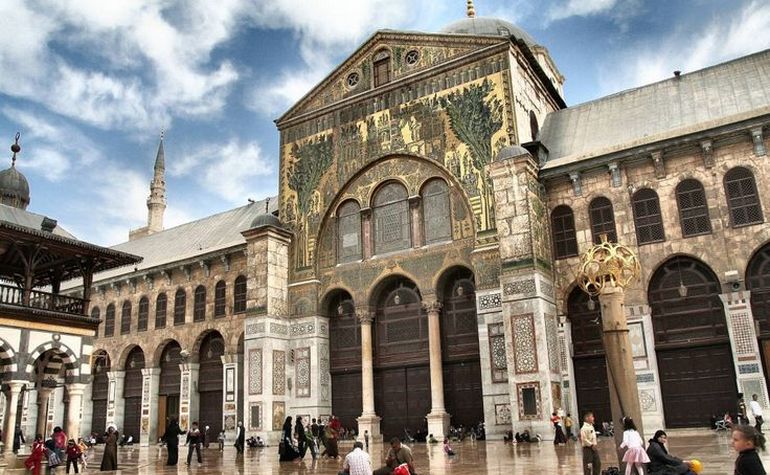
Umayyad Mosque exterior
Exterior of the Umayyad Mosque – Photo: gmiah.hubpages.com
The Umayyad Mosque (or Masjid), also known as the Grand Mosque of Damascus is one of the largest and oldest mosques in the world. It is the first monumental work of architecture in Islamic history.

  • The spot where the mosque now stands was originally a temple dedicated to the idol Hadad in the Aramaean era about 3000 years ago. When the Romans ruled Damascus a temple was built for the worship of Jupiter. It then became a Christian church dedicated to John the Baptist in the Byzantine era towards the end of the fourth century.
  • Following the Battle of Yarmouk in 636 CE, Damascus was conquered by the Muslims under the leadership of Khalid-bin-Waleed (may Allah be pleased with him). The Muslims shared the church building with the Christians for worship. The Muslims prayed in the eastern section of the structure and the Christians in the western side.
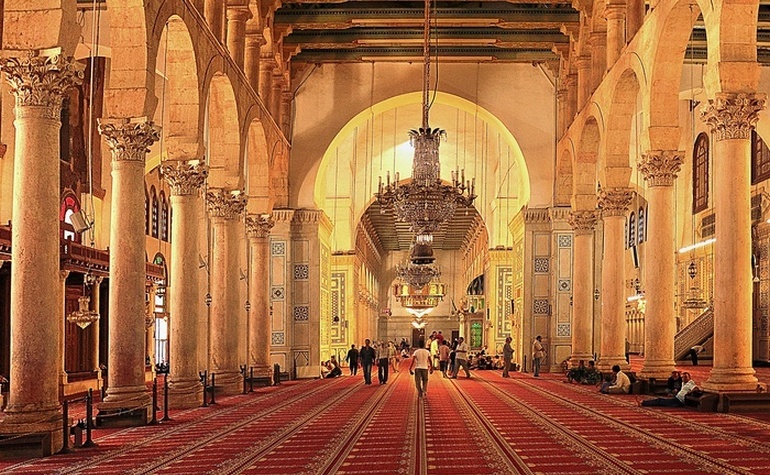
Prayer hall of the Umayyad Mosque
Prayer hall of the Umayyad Mosque – Photo: A. Shamandour
  • This collective use continued until the reign of the Umayyad caliph al-Walid I, when the prayer space became inadequate both in terms of capacity and the need for an architectural monument to represent the new religion. The caliph negotiated with Christian leaders to take over the space, and in return al-Walid promised that all the other churches around the city would be safe, with the addition of a new church dedicated to the Virgin granted to the Christians as compensation. The church was purchased from the Christians before being demolished and between 706 and 715 CE the current mosque was built in its place.
  • Construction of the mosque was based on the mosque of the Prophet Muhammad (peace and blessings of Allah be on him) in Madinah, which had many functions: it was a place for personal and collective prayer, religious education, political meetings, administration of justice, and relief of the ill and homeless. The caliph asked and obtained from the Emperor of the Byzantine Empire for 200 skilled workers to decorate the mosque, as evidenced by the partly Byzantine style of the building. The new mosque was the most impressive in the Islamic world at the time, and the interior walls were covered with fine mosaics. The building became one of the marvels of the world, because it was one of the largest of its time. The exterior walls were based on the walls of the temple of Jupiter and measure 100 by 157.5 m.
  • The Umayyad Mosque holds special significance to Shi‘ah Muslims, as this was the destination of the descendents of the Prophet (peace and blessings of Allah be on him), made to walk here from Iraq, following the battle of Karbala.
  • The prayer hall consists of three aisles, supported by columns in the Corinthian order. It was one of the first mosques (the other being al-Aqsa Mosque in Jerusalem) to have such a shape and in this way, the visitors could see the mihrab, the alcove indicating the direction of Makkah, and each other more easily.
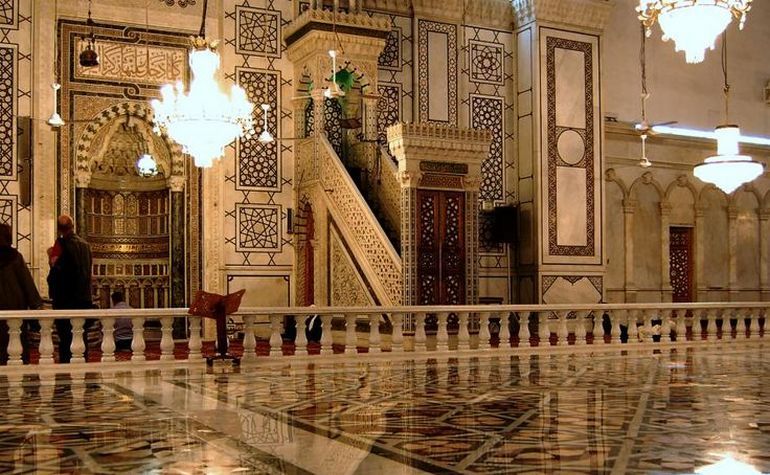
Ummayad mosque mimbar and mihrab
The mimbar (pulpit) and mihrab (prayer niche) – Photo: afghan.delcity91.com
  • In 2001 Pope John Paul II visited the mosque, primarily to visit the relics of John the Baptist. It was the first time a pope had paid a visit to a mosque.

References:  Wikipedia, Archnet.org


Hafsah bint 'Umar

One day the Angel Jibril told Prophet (peace and
blessings be upon him) about Hafsah:
"She is an often fasting and worshipping lady and
she will be your wife in Paradise too." [Mustadrak
Al-Hakim 4/15]
Hafsah was the daughter of 'Umar Faruq, and the
niece of another famous Sahabi, 'Uthman bin
Maz'un. Her uncle from the paternal side was Zayd
bin Khattab. 'Abdullah bin 'Umar was her brother.
Hafsah was an extremely religious lady who used
to spend her time in prayer and fasting. An
excellent writer and orator, an ardent follower of
Islam.
Hafsah had such noble qualities and such an
amiable nature that 'A'ishah remarked that among
wives of the Prophet (peace and blessings be upon
him) only she could compare with her. Her life is
exemplary, brought up as she was by a Companion
of the calibre of 'Umar bin Khattab.
Hafsah was born in the family of a great warrior
and wrestler, 'Umar bin Khattab who was well
known for his martial skills. In her growing years
she was brought up in an Islamic environment,
both her parents and her aunts and uncles having
already converted to the new religion. When she
was old enough, she was married to Khanis bin
Huthafah As-Sahmi. He was influenced by the
teaching of Abu Bakr Siddiq and had accepted
Islam.
Due to worst cruelty and oppression, Khanis had to
migrate to Al-Madinah with his wife. He was
welcomed by Rafa'h bin 'Abdul Munthir and stayed
in his house as his guest.
Both Khanis and Hafsah loved the new life in Al-
Madinah. Hafsah made special arrangements to
memorize the Ayat of the Quran as and when they
were revealed. Then she would give deep thought
and attention to the meaning and interpretation of
the Ayat. Her husband meanwhile was
enthusiastically preparing himself for Jihad and
improving his martial skills. He was constantly
alert to the movements of the enemy and was ever
ready to meet them head on.
News came that the Quraysh of Makkah, after
making elaborate preparations for a war to wipe
out the Muslims, were marching towards Al-
Madinah under the leadership of Abu Jahl.
The Muslims under the leadership of the Prophet
(peace and blessings be upon him), practically
unarmed, reached Badr and set up camp taking
control of the only source of water. All they had
with them was their strong faith in the Allah.
Khanis bin Huthafah, 'Umar Faruq and the
maternal and paternal uncles of Hafsah and her
cousin were all part of this courageous band. Her
husband was determined to win the battle for Allah
and bring to dust the pomp and grandeur of Abu
Jahl's forces. Finally the forces met and Khanis bin
Huthafah went tearing through the ranks of the
enemy. He was seriously wounded, but most of the
leaders of the disbelievers were killed, and Islam
triumphed. It is one of the greatest battles fought
in history where a handful of unarmed and
outnumbered men routed a powerful and well-
equipped army.
When Hafsah heard of her husband's heroic deeds
she was very happy, and praised his valour in
battle; but she also realized that in this condition
he would need the best care possible. She
immediately recited the Ayah of Surat Al-Anfal
which were revealed in connection with the Battle
of Badr,
"Allah made it only as glad tidings, as that your
hearts be at rest therewith. And there is no victory
except from Allah. Verily, Allah is All-Mighty, All-
Wise." [Noble Quran 8:10]
These Words of the Allah Almighty promising
victory inspired her and she happily turned to the
task of nursing her husband back to health. But it
was not to be, for he was to be blessed with an
exalted position. A few days later he succumbed to
his injuries and joined the ranks of those who are
blessed with eternal life. When the Prophet (peace
and blessings be upon him) heard of his passing
away he arranged for him to be buried in Jannatul
Baqi, next to the uncle of Hafsah; he personally led
the funeral prayers. Hafsah was, naturally, grief
stricken, but being a true believer she respectfully
submitted to the Will of Allah. She turned towards
her Maker and courageously gave herself even
more to prayer and meditation. She was at this
time barely twenty-one years old.
For her father it was very painful to see his
daughter in this state. Her silent courage under
these circumstances, her patient prayers and her
study of the Quran irradiated her countenance with
a spiritual beauty and innocence, but there was
also a sadness because of the harsh loneliness
that had become part of her life. After deep
thought 'Umar Faruq decided to approach 'Uthman
bin Affan, whose wife Ruqayyah the Prophet's
daughter, had passed away. He thought that
sharing a common bond would help to alleviate
their sorrow in losing worthy spouses. So, having
taken this decision he went direct to 'Uthman.
After the formal greeting and expression of
condolences on his wife's death he broached the
topic closest to his heart. 'Uthman lowered his
eyes and then after a few moments pause, he said
he needed time to think it over.
'Umar Faruq met him again after a few days and
asked him if he had thought over the proposal.
'Uthman answered that he was not presently
planning on marriage. From there he went to Abu
Bakr Siddiq and offered him his daughter in
marriage. He too lowered his gaze and did not
answer him. Imam Bukhari in his book of Hadith,
As-Sahih Al-Bukhari, has given a whole chapter to
the topic of an honorable man offering his sister or
daughter in marriage.
'Umar Faruq was very upset because both the men
he approached had either avoided or refused
marriage to his daughter. He was confident of a
willing and joyful acceptance but things turned out
otherwise. He was very upset and worried at the
turn of events; in a sense it was an affront to him
and his position as a sincere defender of the faith.
People, he thought, would consider it an honor to
have an alliance by marriage with him. With this
grievance he went to the Prophet (peace and
blessings be upon him) and explained to him the
position he found himself in. The Prophet (peace
and blessings be upon him) smilingly answered
that he should neither grieve nor worry, and Allah
willing he would find a man better than 'Uthman
for Hafsah and 'Uthman in turn, would find for
himself a better woman than Hafsah.
'Umar Faruq was pleased on hearing this from the
Prophet (peace and blessings be upon him)
himself, but also a little perplexed over who such a
man could be? A few days later the Prophet (peace
and blessings be upon him) married his daughter,
Umm Kulthum to 'Uthman. 'Umar Faruq realized
that one part of the prediction had come true, but
he continued to puzzle over the second half of the
statement. Who could possibly be a better man
than 'Uthman? Then the Prophet (peace and
blessings be upon him) proposed marriage to
Hafsah. 'Umar Faruq could not believe his ears; his
daughter would have the honor of joining the select
band of women who were known as the Mothers of
the believers! 'A'ishah and Sawdah were already
part of the Prophet's household. It seemed too
good to be true. Thus Hafsah was joined in
marriage to the Prophet (peace and blessings be
upon him) in the 3rd year after Hijrah, before the
Battle of Uhud. She was about twenty-two years
old at the time. On seeing off his daughter to her
husband's house, 'Umar Faruq told her that she
should never try to compete with 'A'ishah, who
was the Prophet's favorite and better than her in
many respects. He said she should respect her
sincerely and live happily as a member of the first
and foremost family.
Sa'id bin Al-Musayyab, a learned scholar, states
that the Prophet's prediction that he was a better
husband for Hafsah than 'Uthman was proved
right, as was his statement that Umm Kulthum
was a better wife for 'Uthman than Hafsah. After
the marriage Abu Bakr Siddiq met with 'Umar
Faruq and told him the truth, which was that the
Prophet (peace and blessings be upon him) had
mentioned to him that he planned to marry
Hafsah. That was the reason he had remained
silent, as it would not have been proper to betray
his confidence. If matters were different he would
have been only too happy to accept her hand in
marriage. 'Umar Faruq expressed his happiness by
quoting the following Ayah,
"This is by the Grace of my Lord - to test me
whether I am grateful or ungrateful! And whoever
is grateful, truly, his gratitude is for himself; and
whoever is ungrateful, (it is for the loss of only
himself). Certainly my Lord is Rich,
Bountiful." [Noble Quran 27:40]
After attaining the position of the Mother of the
Believers, Hafsah became even more absorbed in
studying the finer points of religion. She would
store in her mind conversations of Muhammad
(peace and blessings be upon him) which would
lead to a better understanding of Islam. Often she
would discuss any points that arose in her mind
about the Shari'ah.
Jabir bin 'Abdullah Ansari narrates an incident
which was related to him by Umm Mubasher. She
and Hafsah and the Prophet (peace and blessings
be upon him) were sitting and chatting together.
He said that all the people who had given the
pledged of allegiance at Hudaybiyah under the tree
would go to Paradise, and not to Hell. She asked
how that was possible. The Prophet (peace and
blessings be upon him) got annoyed, but Hafsah
did not give up and quoted an Ayah from Surah
Maryam.
"There is not one of you but will pass over it (Hell)
." [Noble Quran 19:71]
In reply he quoted the very next Ayah, also from
Surah Maryam.
"Then We shall save those who use to fear Allah
and were dutiful to Him. And We shall leave the
wrongdoers therein to there knees (in Hell)." [Noble
Quran 19:72]
This news of Hafsah disputing with the Prophet
(peace and blessings be upon him) spread in Al-
Madinah. On that day the Prophet (peace and
blessings be upon him) was very disturbed; and
when 'Umar Faruq heard about it he chided his
daughter. She replied that 'A'ishah too spoke in
the same manner to him. Her father again
cautioned her not to compete with 'A'ishah and
maintain a certain decorum, or else she would
bring trouble on herself.
Among the Mothers of the believers, 'A'ishah, Umm
Habibah, Sawdah and Hafsah all belonged to the
tribe of Quraysh. The others came from various
other tribes. Everyday after the 'Asr prayer, the
Prophet (peace and blessings be upon him) would
visit them all for a little while to see if they needed
anything; the time of the visits was routine and
each would wait eagerly for his arrival. On several
occasions, it so happened that he spent more time
with Zaynab. This upset 'A'ishah, and she spoke
about it to Hafsah and Sawdah. They got together
and found out that a certain relative had sent
Zaynab a special kind of honey and she used to
offer it to the Prophet (peace and blessings be
upon him) everyday. This was his favorite and he
used to be delayed in her apartment, enjoying it.
'A'ishah was so fond of the Prophet (peace and
blessings be upon him) that she could not bear for
him to be late coming to her apartment. Because
of her regard for him she could not object directly.
So she consulted Hafsah and Sawdah, and they
decided that when he comes to each of us by turn,
we would all say that there is a strange smell
emanating from his mouth. When he heard the
same thing from all three of them, he believed it
must be due to the honey he had, and decided to
give it up for good. If this had been an incident in
the life of an ordinary person it would have been of
no consequence. But this was with the last Prophet
of Allah and his every word and every action would
become the law or Shari'ah for all Muslims for all
time to come. Thus it had a special significance.
So Allah rebuked him in Ayah of Surat At-Tahrim.
"O Prophet! Why do you forbid (for yourself) that
which Allah has allowed to you, seeking to please
your wives? And Allah is Oft-Forgiving, Most
Merciful." [Noble Quran 66:1]
It was around the same time that the Prophet
(peace and blessings be upon him) confided a
secret matter to Hafsah, and warned her not to
speak to anyone about it. But she told 'A'ishah.
Allah then revealed to the Prophet (peace and
blessings be upon him) what happened. Allah
revealed this in the following Ayah of Surat At-
Tahrim,
"And when the Prophet disclosed a matter in
confidence to one of his wife, then she told it. And
Allah made it known to him; he informed part
thereof and left a part. Then when he told her
thereof, she said: "Who told you this?" He said:
"The All-Knower, the All-Aware has told
me." [Noble Quran 66:3]
The year, when the Peninsula was under the
Islamic government, the granaries were full and all
the riches were reaching the centre from the
different regions of Arabia; many of the wives of
the Prophet (peace and blessings be upon him),
who lived lives of luxury, put forward demands for
an increase in their household allowances. When
'Umar Faruq heard of this he was very upset; he
told his daughter Hafsah that she should ask her
father if she needed anything and not make any
demands on the Prophet (peace and blessings be
upon him). He also advised all the Mothers of the
Believers not to make any demands. Umm
Salamah did not quite like this and felt that he had
the habit of interfering in every matter. She told
him frankly that he should refrain from meddling in
the affairs of the Prophet's wives.
It was at this time that the Prophet (peace and
blessings be upon him) had fallen from his horse
and been injured; keeping all these things in view
he decided to go into seclusion and moved to an
upper room adjacent to the apartment of 'A'ishah.
The whole city was buzzing with the gossip the
hypocrites spread saying that he divorced his
wives. But actually no such thing happened. All the
Companions were disturbed by this situation, but
no one had the courage to approach the Prophet
(peace and blessings be upon him) and talk to him
directly. Finally 'Umar Faruq known for his
forthrightness went to him and asked him if the
rumor was true. When he denied it he was
delighted. Then he asked if he could announce this
good news to the rest of the Muslims. When he
received permission, he joyfully informed the
community that everything was fine with the
Prophet's household. The whole city was relieved
that the Messenger of Allah had not been offended
in any way. On the twenty-ninth day he came
down into the apartment of 'A'ishah. She asked
him smilingly why he came down before the month
was over. He replied that often the lunar month did
consist of only twenty-nine days. Hafsah promised
her father that she would never ever ask for a raise
in her allowance and she stood by her word to the
end of her life.
Hafsah died in the year 41st after Hijrah aged fifty-
nine. At the time of death she was fasting. The
funeral prayers were led by the governor of Al-
Madinah, Marwan bin Al-Hakam. Abu Hurairah and
Abu Sa'id Khudri, the eminent Companion of the
Prophet (peace and blessings be upon him) were
among those who carried the shroud to Jannatul
Baqi'. Her two brothers, 'Abdullah bin 'Umar and
'Asim bin 'Umar placed her gently into her final
resting place. Salem bin 'Abdullah, 'Abdur-Rahman
bin 'Abdullah and Hamzah bin 'Abdullah, all the
sons of 'Abdullah bin 'Umar also attended the
funeral.
And so a righteous and learned writer and reciter of
the Noble Quran who devoted herself from her
youth to prayer, fasting and meditation passed into
history.
These Ayat from Surat Al-Qamar express an apt
tribute to this great Mother of the Believers.
"Verily, the pious will be in the midst of Graders
and Rivers (Paradise). In a seat of truth, near the
Omnipotent King." [Noble Quran 54:54-55]

Wednesday, December 3, 2014

A Australian women revert to ISLAM

Assalamu alaikum wa rahmatullahi wa barakatuhu.
I'm an Australian revert, none of my family are
Muslim but me
and I'm happy being muslim.
I wear hijab first time I put it on so much respect
everyone call me sister. allhamdulillah.
I used to have a hard life in the past time and
used a lot of bad ways of men, but not anymore,
this religion has protected me like I can't describe,
I feel naked without it.
I encourage all female to embrace hijab.
Hijab is my right, my choice and my life, I support
all muslims
bye. - Katie (Australia)

Tuesday, December 2, 2014

Ayshah bint Abu Bakr

'Ayshah was born in 614 CE, she had claims to
noble birth from both sides of the family. Her
mother was Umm Roman and her father was Abu
Bakr As-Siddiq.
She said that there were nine blessings of Allah
which distinguished her from all other women in
the world except Maryam bint 'Imran, the mother
of 'Issa.
The Angel Jibril had presented her portrait wrapped
in green silk to Muhammad (peace and blessings
be upon him) and told him that this was the
picture of the lady chosen by Allah, to be his
consort both in this world and the next.
She was the only virgin to have become the wife of
the Prophet (peace and blessings be upon him).
When the Prophet passed away, he was resting in
her lap and was buried in her apartment.
Many times angels encircled her apartment with
love and respect.
Very often divine revelation would come to
Muhammad (peace and blessings be upon him)
when they were lying together resting in peace and
tranquility.
She was the daughter of a true friend of the
Prophet (peace and blessings be upon him), Abu
Bakr As-Siddiq.
Ayat had descended from the heavens from Allah
proving her innocence.
She was born a Muslim and had been brought up
in a pure environment, and spent her formative
years with the best of creatures, the Prophet
(peace and blessings be upon him).
Allah, the Lord, the Sustainer of the Universe
promised her Divine Forgiveness and abundant
bounties.
As a girl she used to play with dolls, Once
Muhammad (peace and blessings be upon him)
visited her father, he saw her playing with a
winged horse; she was barely five years old at the
time. When he inquired she said it's a horse. He
smiled and answered that horses didn't have
wings! She promptly retorted that the Prophet
Sulaiman had winged horses, which showed even
at this tender age she was intelligent on religious
and historical matters. At the age of 8 years, she
experienced an historic move, when the first
Islamic state was on rise, she was able to recall all
the minor details. Next year she joined the
household of the Prophet (peace and blessings be
upon him).
Small rooms were constructed around the
Prophet's Mosque, and Ayshah occupied one of
these, on the eastern side of the Mosque it had
earthen walls with a roof made of leaves and twigs.
It was covered with a blanket to prevent rainwater
from seeping through and the roof was so low that
a person standing upright could touch it. The door
never closed and a blanket hung as curtain. Close
to the room, on a slightly higher level was another
small room. A mat, a thin mattress, a pillow filled
with the bark of trees, a water bag, a small plate
for dates and a glass for drinking water were all
the things in the room. This sparse little room was
filled with spiritual treasures.
When the whole of Arabia was under authority of
Islam, huge quantities of grain and cash flowed
into the central treasury. But on the day that
Muhammad (peace and blessings be upon him)
passed away, there was not even food for a single
day in his household. Ayshah maintained this
tradition up to her last days.
Ayshah was very charitable, all money that came
her way was given away as soon as possible One
day a beggar came to her and asked for food. She
told her maid to give the lady the piece of bread
they had. The maid answered that there was
nothing else with which she could break her fast.
'Ayshah said help the hungry woman and the
evening would take care of itself. By the blessings
of Allah in the evening someone sent her a dish of
cooked meat; She also sold the house she owned
to give the price in charity.
She loved her sister's son, 'Abdullah bin Zubayr,
very deeply. He loved her and always looked after
her needs. Once he remarked that her generosity
needed to be restrained. 'A'ishah was upset when
she heard this; she swore she would never to talk
to him. Finally, when she calmed down and made
up with him, she freed several slaves as penance
for breaking her oath.
'Ayshah was soft-hearted. On one occasion when a
beggar carrying two children came to her door;
Ayshah had only three dates in the house. These
she gave her; the woman gave one each to the
children and started eating one herself. One of the
children ate his share quickly and started looking
at his mother eating her date. The woman could
not bear her child's hunger and took the date from
her mouth, broke it into two halves, and gave a
piece to each of the children. When 'Ayshah saw
this heart-rending scene she could not control her
tears.
In the month of Sha'ban, Ayshah accompanied
Muhammad (peace and blessings be upon him)
who led the Muslim army towards Qadid, where a
minor battle started with tribe of Banu Mustalaq.
Several hypocrites were also part of the army
during this particular battle. She had borrowed a
necklace from her sister Asma'. On the way back
the army camped in the desert, and Ayshah went
far into desert to relieve herself. Suddenly she
realized that the necklace dropped along the way.
She found it after a long search. When she reached
the site, the caravan had left, the normal procedure
was that the ladies, who were segregated from the
men folk, would get into their litter and draw the
curtains. Then the camel drivers would place the
litter on the camel's back. Since 'Ayshah was very
light no one realized her absence. She lay down,
waiting for her companions to return.
Safwan bin Mu'attil had the responsibility of
checking the camp site for things which might have
been left behind, at daybreak he arrived to find
someone lying down in a Jilbab. When 'Ayshah
heard him she woke up, and got on to the camel.
He then walked leading the camel by the bridle.
At noon when the caravan had just reached the
next camp site to rest, they saw 'Ayshah arriving
with Safwan. Madinah was flooded by loose talk
that 'Ayshah was a loose woman and her
character was suspect, led by 'Abdullah bin Ubayy
bin Salul. Hasan bin Thabit, Hamnah bint Jahash,
and Mastah bin Athathah who joined the
hypocrites. The Prophet (peace and blessings be
upon him) was extremely disturbed when he heard
this talk, but 'Ayshah was blissfully ignorant of all
this.
One night when she went out with the mother of
Mastah bin Athathah. The lady tripped and started
cursing her son. 'Ayshah said that he was a
Companion of the Prophet (peace and blessings be
upon him) who fought in the Battle of Badr and
deserved respect. The old lady retorted that
'Ayshah was ignorant of the fact that he was
involved in an awful plot; she revealed what had
been taking place behind her back. On returning
home, she took the permission of Muhammad
(peace and blessings be upon him), and went to
visit her parents. She was heartbroken, her
sympathetic and loving parents advised her to be
patient and everything would be cleared up. But
she could not accept the fact that people could
descend to such cruel depths. After two days and
nights of continuous weeping she fell ill.
On the third morning, the Prophet (peace and
blessings be upon him) came to see her. He told
her very gently that if she erred she should ask
Allah for His forgiveness. She said to her husband
that if she denied she was guilty, nobody would
believe her; but she was innocent and only Allah
knew it. The best answer to these accusations was
to quote the answer of the father of Yusuf,
"So (for me) patience is most fitting. And it is
Allah Whose help can be sought against that (lie)
which you describe." [Noble Quran 12:18]
At precisely this moment, the Ayat announcing her
innocence were revealed. When the revelation
ended he then turned to 'Ayshah with a smile and
started reciting the Ayat,
"Verily, those who brought forth the slander are a
group among you. Consider it not a bad thing for
you. Nay, it is good for you. Unto every man
among them will be paid that which he earned of
the sin, and as for him among them who had the
greater share therein, his will be a great torment.
Why then, did not the believers, men and women,
when you heard it (the slander), think good of their
own people and say: "This (charge) is an obvious
lie?" Why did they not produce four witnesses?
Since they (the slanderers) have not produced
witnesses! Then with Allah they are the liars. Had
it not been for the Grace of Allah and His Mercy
unto you in this world and in the Hereafter, a great
torment would have touched you for that whereof
you had spoken. When you were propagating it
with your tongues, and uttering with your mouths
that whereof you had no knowledge, you counted it
a little thing, while with Allah it was very great.
And why did you not, when you heard it, say: "It is
not right for us to speak of this. Glory be to You
(O Allah)! This is a great lie." Allah forbids you
from it and warns you not to repeat the like of it
forever, if you are believers. And Allah makes the
Ayat plain to you, and Allah is All-Knowing, All-
Wise. Verily, those who like that (the crime of)
illegal sexual intercourse should be propagated
among those who believe, they will have a painful
torment in this world and in the Hereafter. And
Allah knows and you know not. And had it not
been for the Grace of Allah and His Mercy on you,
(Allah Would have hastened the punishment upon
you). And that Allah is full of kindness, Most
Merciful. O you who believe! Follow not the
footsteps of Shaytan. And whosoever follows the
footsteps of Shaytan, then, verily, he commands
Al-Fahsha' (illegal sexual intercourse), and Al-
Munkar (evil and wicked deeds). And had it not
been for the Grace of Allah and His Mercy on you,
not one of you would ever have been pure from
sins. But Allah purifies (guides to Islam) whom He
wills, and Allah is All-Hearer, All-Knower." [Noble
Quran 24:11-21]
Her parents were proud and relieved; pride that
their daughter had been honored with a Quranic
revelation, and relief that she was acquitted of any
wrongdoing. They asked their daughter to rise and
thank her husband, 'Ayshah promptly replied that
she was grateful to her Allah for He had revealed
Quranic Ayat in her honor. This episode is known
in Islamic History as the Event of Al-Ifk.
After this incident the Prophet's respect for
'Ayshah increased even more. 'Amr bin 'Aas once
asked Muhammad (peace and blessings be upon
him) who he loved most in this world, and he
replied that he loved 'Ayshah more than anyone
else. Then he asked him about the men folk. And
the Prophet (peace and blessings be upon him)
answered that he loved Ayshah's father the most.
On one occasion 'Umar told his daughter Hafsah
not to try and compete with 'Ayshah as
Muhammad (peace and blessings be upon him)
valued her very highly.
The Prophet (peace and blessings be upon him)
loved to listen to 'Ayshah talking and always
smiled when she spoke. On one 'Eid day there were
some Africans displaying their skill with spears;
'Ayshah wanted to watch, so the Prophet (peace
and blessings be upon him) stood in front of her
so she could enjoy and not be seen. And he did
not move until she tired of it.
But all this pleasant entertainment could not
distract Muhammad (peace and blessings be upon
him) from his duty to Allah. When the Mu'adthin's
call to prayer would be heard, he immediately
would rise and prepare to go the mosque, the love
for Allah had priority over all other affections and
interests.
Once they camped at a place in the desert and
again 'Ayshah's necklace fell off. Some of the
companions were sent to find it. When the call for
morning prayers was given, there was no water for
ablution. The Companions were worried about the
morning prayers, and held Ayshah responsible. Her
father rebuked his daughter for creating a situation,
which might lead to the prayers being missed.
Exactly at this moment this Ayat was revealed to
the Prophet (peace and blessings be upon him),
"And if you are ill, or on a journey, or one of you
comes after answering the call of nature, or you
have been in contact with women (by sexual
relations) and you find no water, perform
Tayammum with clean earth and rub therewith
your face and hands. Truly, Allah is Ever Oft-
Pardoning, Oft-Forgiving." [Noble Quran 4:43]
The people expressed their thanks for such a great
favor Allah granted because of her. Abu Bakr As-
Siddiq had not realized until that moment how
pleased Allah was with her.
By the ninth year after Hijrah, Islam had spread
over most of Arabia. Madinah became a flourishing
state. Some wives of the Prophet (peace and
blessings be upon him) requested a increase in
allowances. This disturbed the Prophet (peace and
blessings be upon him) and he declared that for
one month he would separate himself from his
wives, and he went into seclusion.
After 29 days he came to 'Ayshah's apartment,
and told her to make a choice after consulting her
parents; choose him and a life of hardship, or leave
him and lead a life of ease. 'Ayshah had no doubt
in her mind; she immediately answered that she
and her parents would sacrifice their lives for him if
need arose, there was no need to consult her
parents and she would prefer life with him to the
world and its attractions. A beautiful smile lit his
face. And then Allah revealed the following,
"O Prophet Say to your wives: 'If you desire the
life of this world, and its glitter, them come! I will
make a provision for you and set you free in a
handsome manner (divorce). But if you desire Allah
And His Messenger, and the Home of the hereafter,
then verily, Allah has prepared for the good-doers
among you an enormous reward." [Noble Quran
33:28-29]
All the wives took the same decision as 'Ayshah.
In two recorded incidents Ayshah saw Jibril
personally.
On one occasion, 'Ayshah saw the Prophet (peace
and blessings be upon him) talking to a rider of a
horse. When she inquired about the stranger, he
was surprised that she saw him and told her it
was the Angel Jibril as human and sent greetings
to you. She prayed that Allah give reward to the
honored guest and to noble host.
Anas narrates: Once Prophet (peace and blessings
be upon him) was praying in 'Ayshah's apartment,
she saw someone standing outside the door. When
he finished his prayers she informed him. It was
angel Jibril. Muhammad (peace and blessings be
upon him) invited him inside but he replied that
they don't enter where there were dogs or
pictures. When Prophet (peace and blessings be
upon him) looked around he saw a puppy in a
corner of the room; when he was chased out then
the angel entered.
'Ayshah attained a lofty status because of her
knowledge. Everyone consulted her on the finer
points of religion. Many Hadiths originated from
her 2210 in number.. She was among the top
seven companions who narrated thousands of
Hadiths.
Imam Dthahabi wrote that she was a theologian of
the highest order. She imbibed divinely inspired
knowledge and wisdom from the very fountainhead
of Prophethood and an eyewitness to problems and
their answers by divine revelations. Her apartment
was the centre where Ayat were revealed by the
divine Mercy of Allah. Thus she was given the title
of 'Horizon of the Ladies of Islam'.
During the time of Khulafa-u-Rashidin, her Fatwas
were accepted. Once someone asked Masruq if
'Ayshah had mastery over Shari'ah laws regarding
inheritance. He swore that he had seen
Companions asking her questions about the finer
points of the laws of inheritance. 'Urwah bin
Zubayr, her sister Asma's son often visited her to
discuss religious issues with her. Other
Companions envied him as he could freely
approach her at any time.
Once the Prophet (peace and blessings be upon
him) and 'Ayshah were not feeling well. The
Prophet (peace and blessings be upon him) said
that if she died before him he would bathe her and
shroud her and lower her into her grave and pray
for her. She light heartedly replied that it seemed
as if he would celebrate her death; and she told
him that in case she died before him, he should
bring a new wife into her apartment. The Prophet
(peace and blessings be upon him) smiled at this.
Her brother, 'Abdur-Rahman came in during his
last moments with a Siwak in his hand; the
Prophet (peace and blessings be upon him) looked
longingly at it. 'Ayshah understood and asked him
if she could offer one to him. When he nodded, she
took it and softened it with her teeth and offered it
to him. He cleaned his teeth; and dipping his hand
frequently in water, he kept wiping his face again
and again, repeating the words,
"There is none worthy of worship but Allah. Verily,
death has pains." Then he pointed upward with his
hand and said, "Toward the best friend"
Ayshah once had a dream that three moons
descended into her apartment. When the Prophet
(peace and blessings be upon him) passed away
he was buried in her apartment. Her father told her
that part of her dream came true that day - the
first moon irradiated her apartment. Later, her
father and then Umar Al-Khattab was buried next
to the Prophet (peace and blessings be upon him)
which fulfilled the prophesy of her dream.
Imam Dthahabi quoted a saying of the Prophet
(peace and blessings be upon him) that a
Prophet's soul leaves its body in the place that it
likes the best. Thus it is proven he died in his
favorite place, the apartment of 'Ayshah.
She left this earthly existence for Paradise in the
year 58 Hijrah on the 17th of Ramadhan at the age
of 66.
She was buried in Jannatul Baqi'. with Abu
Hurairah leading the funeral prayers.

Monday, December 1, 2014

Resting place of the Ark of Prophet Nuh (upon him be peace)

Mount Judi is the resting place of the Ark built
by Nuh (upon him be peace) by the command of
Allah. It is situated in south-east Turkey, close
to the Syrian and Iraqi borders. The Quranic
account of the Flood and Noah’s Ark agrees with
that given in the Bible, with a few variations. One
of these concerns the final resting place of the
Ark. According to Genesis, the Ark grounded on
the “mountains of Ararat”; while according to
Surah 11:44 of the Qur’an, the final resting place
of the vessel was called Mount Judi:
“Then the word went forth: “O earth! Swallow up
thy water, and O sky! Withhold (thy rain)!” and
the water abated, and the matter was ended. The
Ark rested on Mount Judi, and the word went
forth: “Away with those who do wrong!” [11:44]
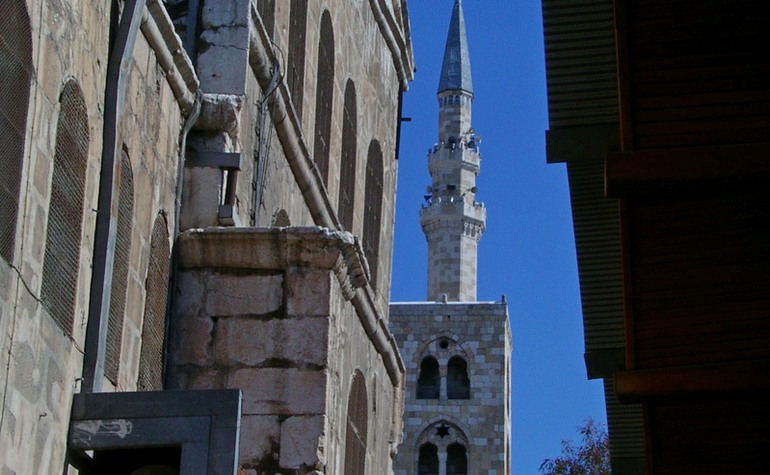
The picture above is believed to be the current
remains of the Ark on the mountain.
References: Wikipedia

Khadijah bint Khuwaylid

Narrated Abu Hurairah: Jibril (Gabriel) came to the
Prophet (peace and blessings be upon him) and
said: "O Allah's Messenger! This is Khadijah,
coming to you with a dish having meat soup (or
some food or drink). When she reaches you, greet
her on behalf of her Lord (Allah) and on my behalf,
and give her the glad tidings of having a palace
made of Qasab in Paradise, wherein there will be
neither any noise nor any toil, (fatigue, trouble,
etc.)." [Al-Bukhari]
'Abdullah bin 'Abbas narrated that one day the
Prophet (peace and blessings be upon him) drew
four lines on the earth and asked his Companions
if they understood what these lines stood for. They
respectfully replied that he knew better. He then
told them that these lines stood for the four
foremost ladies of the universe. They were
Khadijah bint Khuwaylid, Fatimah bint Muhammad,
Maryam bint Imran, the mother of the Prophet Issa
and 'Asia bint Muzahim (the wife of the Pharaoh).
She was the first person to have an abiding faith in
the utterances of the Prophet (peace and blessings
be upon him) and to accept Islam as her religion
and her way of life. She was blessed with the
distinction of having been greeted with Salam
(greetings) by Allah and the Angel Jibril.
Khadijah was born in Makkah in the year 556 CE.
Her mother's name was Fatimah bint Zayd, and
her father's name was Khuwaylid bin Asad. He was
a very popular leader among the tribe of Quraysh,
and a very prosperous businessman who died
while fighting in the famous battle of Fujjar.
Khadijah thus grew up in the lap of luxury. She
married Abu Halah Malak bin Nabash bin Zarrarah
bin At-Tamimi and bore him two children, Halah
and Hind. She wanted to see her husband prosper
and financed him in setting up a big business. But
unfortunately he passed away. Some time later the
young widow married 'Atique bin 'Aith bin
'Abdullah Al-Makhzumi, and she had a daughter by
him as well named Hindah, but the marriage soon
broke up on grounds of incompatibility. After this
all her attention was devoted to the upbringing of
her children, and building up the business she
inherited from her father. Her astuteness and
business ability made her business one of the most
widespread businesses among the Quraysh.
Her policy was to employ hard working, honest and
distinguished managers to deal on her behalf as a
lot depended on the integrity of the employees who
traveled far and wide on her behalf. She exported
her goods to far away markets like Syria, and her
managers bought goods from those markets to be
sold at home.
Khadijah had heard of the integrity, honesty and
principled behavior of the Prophet (peace and
blessings be upon him) and sent a job offer to him
to head her trading caravans. He gladly accepted
the offer and started working for her. Khadijah sent
him on a business trip; her old and trusted slave
Maysarah being delegated to accompany and serve
him.
Maysarah was impressed by the Prophet's
integrity, strength of character, adherence to
principles, his amicable dealings and his business
abilities. On the way back from Syria, the Prophet
(peace and blessings be upon him) lay down under
a tree to rest for a while. Nestora, a Jewish monk,
noted for his knowledge of religion and for his
insight saw him and asked Maysarah who he was.
Maysarah told him all about Muhammad (peace
and blessings be upon him) and his reputation for
honesty and intelligence. Nestora then told him
that this man would be elevated to Prophet hood
in the future, as no man had ever rested under that
particular tree but Prophets.
Tradition has it that Maysarah also saw two
angels bearing a cloud over Prophet's head to
protect him from the glare and heat of the sun.
When he returned home Maysarah reported to
Khadijah all that had taken place on the trip to
Syria. She was deeply moved and impressed, and
started thinking of proposing marriage to
Muhammad. But how could she express her
thoughts to him? She already rejected several
proposals of marriage from men belonging to some
of the noblest families of the Quraysh. How would
her tribe react? What would her family say? And
what was more, would her proposal be acceptable
to this young, yet unmarried man of the tribe of
Quraysh?
As she pondered over these questions and debated
within herself, one night she dreamt that the
shining sun had descended from the heavens into
her courtyard, radiating her home. When she woke
up she went for the interpretation of this wonderful
dream to her cousin, Waraqah bin Nawfal, a blind
man noted for his skill in interpreting dreams, and
for his depth of knowledge, particularly of the
Torah and the Injil. When he heard her dream, he
gave a serene smile, and told her not to worry, as
this was a very promising dream. The glorious sun
she saw descending into her courtyard indicated
that the Prophet (peace and blessings be upon
him) whose advent had been predicted in the
Torah and the Injil was to grace her home and she
would gain from his presence in her life.
After this meeting with Waraqah she became
stronger in her desire to marry Muhammad (peace
and blessings be upon him). One of her very close
friends, Nafisah bint Manbah knew of her
inclination and she went to Muhammad (peace and
blessings be upon him) and requested his
permission to ask him a very personal question.
When he said he had no objection, she asked why
he had not yet got married. He said he did not
have the financial resources. Then she asked him if
he would be willing to marry a beautiful lady from
a noble and wealthy family, who was inclined
towards marriage with him. He asked whom she
was referring to; when he learnt her identity he
said that he was willing, provided she was willing
to marry him. Khadijah' was overjoyed.
The Prophet (peace and blessings be upon him)
was then twenty-five years of age and Khadijah
was forty years old. (According to one tradition,
she was twenty-eight). The two uncles of the
Prophet (peace and blessings be upon him)
Hamzah and Abu Talib approached her uncle,
'Umar bin Asad, with the formal proposal. It was
accepted and the two families began preparing for
the wedding. Halimah As-Sa'diyyah who nursed
the Prophet in his infancy was specially invited for
the wedding and traveled to Makkah from her
village. When she left after the festivities, Khadijah
presented her with household goods, a camel and
forty goats as an expression of gratitude to the
lady who had taken such good care of Muhammad
(peace and blessings be upon him) in his infancy.
Khadijah was very blessed in the marriage, and
had six children. First two sons, Qasim and
'Abdullah; then followed the daughters, Zaynab,
Ruqayyah, Umm Kulthum and Fatimah. It was a
very happy, peaceful and content household, but
Muhammad (peace and blessings be upon him) felt
something was missing, and he was extremely
restless. He would retire for a month once a year
to the cave of Hira to dedicate himself entirely to
prayer and meditation. One day he felt the
presence of another being who held him in his
arms in a tight embrace. Then he loosened his
hold and asked him to read; Muhammad (peace
and blessings be upon him) answered that he was
illiterate. But the person repeated the same act and
the phrase again and again. Then finally he read
these Ayat which are the first revelation of the
Quran. They are from Surah Iqra or Al-'Alaq.
"Read! In the Name of your Lord Who has created
(all that exists). He has created man from a clot.
Read! And your Lord is the Most Generous. Who
has taught (the writing) by the pen. He has taught
man that which he knew not." [Noble Quran
96:1-5]
Then the being disappeared. This was such an
awesome experience that the Prophet (peace and
blessings be upon him) returned home sweating
and shaking. He called out to Khadijah asking her
to cover him with a sheet or a blanket. When he
had calmed down to some extent, he told his wife
that he feared for his life, and narrated the whole
incident to her. Khadijah, a picture of loyalty and
serenity consoled him saying that Allah would
surely protect him from any danger, and would
never allow anyone to revile him as he was a of
man of peace and reconciliation and always
extended the hand of friendship to all. He never
lied, always hospitable, carried the burdens of
others and helped those who were in trouble.
These soothing and encouraging words of
sympathy and understanding from Khadijah gave
him immeasurable strength and confidence. She
then took him to meet her cousin, Waraqah bin
Nawfal, who immediately guessed the identity of
the being in the Cave of Hira as the Angel Jibril the
Messenger of Allah who had visited Moses as well.
Waraqah who was very old wished that he could
live to see the time when the Prophet Muhammad
(peace and blessings be upon him) would be
forced into exile by his people. The Prophet (peace
and blessings be upon him) was very surprised
and asked if his people would really do this to him.
Waraqah assured him that it was typical of human
beings that they would never appreciate or follow a
Prophet who rose among them. Waraqah added
that he wished he were alive at that time and be
able to help him. He added that if what he had
been told were true then surely it meant that her
husband was the Prophet of Allah (peace and
blessings be upon him) whose advent had been
mentioned in the scriptures.
The four daughters grew up to be faithful and
courageous daughters of Islam. They all migrated
to Al-Madinah, with the Prophet (peace and
blessings be upon him).
Zaynab was married to Abu 'Aas bin Rabi'ah,
Ruqayyah was married to 'Uthman. When she
passed away he married her sister Umm Kulthum;
Fatimah was married to 'Ali bin Abi Talib. The first
three daughters died during the lifetime of
Muhammad (peace and blessings be upon him)
and his beloved daughter Fatimah lived just six
months after he passed away.
When the disbelievers saw that Islam was
attracting more and more followers in spite of all
their tactics, they decided to declare an open and
total political and economic boycott of the tribe of
Banu Hashim. This took place in the seventh year
after the Prophet (peace and blessings be upon
him) declared himself the Messenger of Allah. This
is also known in Islamic history as the Shi'ab Abi
Talib.
It was so severe that innocent children faced
starvation and hunger, and adults survived eating
the leaves of trees. Yet the firm followers of
Muhammad did not turn away from their true
religion and they came out of the ordeal stronger
and purer than before.
Khadijah who had been brought up in luxury in her
wealthy father's home now faced the economic
hardships with patience and courage, which are a
necessary part of any siege. Khadijah's nobility of
character and conduct pleased Allah, so much that
He sent special greetings for her.
Khadijah was the ideal wife and mother. The
Prophet (peace and blessings be upon him) lived in
her house which became a blessed place due to
his presence and the fact that Jibril (peace and
blessings be upon him) came often to visit him
there with Quranic revelations. It became the
centre of Islam, where all the Companions male
and female visited often to partake of the
hospitality of Muhammad (peace and blessings be
upon him) and his wife.
After the Hijrah (migration) of the Prophet (peace
and blessings be upon him) to Al-Madinah, the
house was occupied by the brother of 'Ali. Later
Mu'awiyah bin Abu Sufyan who transcribed some
of the Divine Revelations purchased this house and
built a mosque. Thus the site of the house of
Khadijah became a place of prayer and worship for
all time. She had been used to praying two Rak'as
of Salat (prayer), mornings and evenings with the
Prophet (peace and blessings be upon him), even
before prayers were made compulsory by Allah.
After accepting Islam she became more
contemplative and inclined towards worship; she
found a blessed feeling of peace in prayer.
Afif Kindi relates that 'Abbas bin 'Abdul Muttalib
was a great friend of his and he used to visit him
often in Yemen in connection with his business in
perfumes. On one occasion when they were
standing and chatting in Mina, they saw a
handsome young man approach. He carefully
washed his hands and feet and then stood
respectfully with his arms crossed on his breast.
Soon a dignified lady of noble bearing and a young
handsome young lad joined him. 'Afif asked 'Abbas
what they were doing and whether this was a new
form of exercise. 'Abbas replied that the youth was
his brother 'Abdullah's son, and the lady was his
wife. She was a woman of great wealth and virtue,
and an ideal wife and mother. The lad was his
brother Abu Talib's son. Muhammad (peace and
blessings be upon him) had announced that he
was a Messenger of Allah and had started
preaching a new religion called Islam. In due
course 'Afif accepted Islam, but he always
regretted the fact that he had not joined the
Muhammad (peace and blessings be upon him)
and his Companions in their prayers and
supplication on that memorable day in Mina, when
he had first heard of Islam.
Khadijah passed away just three years before the
Hijrah, or the Prophet's (peace and blessings be
upon him) migration to Al-Madinah. She died at
the age of sixty-five, having given almost twenty-
five years to Muhammad and the cause of Islam.
When Muhammad (peace and blessings be upon
him) saw her in the throes of death he consoled
her saying Allah had so ordained it, and that the
thing she was dreading, would prove favorable for
her. Her eyes lit up and as she gazed at her
beloved husband, her soul left its earthly body.
Her grave was prepared at a place called Hujjun,
near Makkah. Muhammad (peace and blessings be
upon him) stepped into it to see that everything
was as it should be, and with his own hands
lowered her gently into it. Thus passed away the
'Mother' of all Muslims, the one who had sacrificed
her all for Islam, the lady who was the greatest
supporter of Islam in its earliest days. She who
was the mother of Fatimah, the First Lady of
Paradise, the grandmother of the beloved
grandchildren of the Prophet (peace and blessings
be upon him) Hasan and Hussein who are to be
the foremost of the youths in Paradise.
When she passed away, the Prophet (peace and
blessings be upon him) was heartbroken at the
loss of a dedicated companion who stood by him
during the most difficult period of his life.
One of the ladies of the Quraysh, Khawlah bint
Hakim, visited the Prophet (peace and blessings be
upon him) to console him, and saw his state of
depression and grief and remarked on it. He replied
it was only natural that he should be touched by
her absence, as she had been a loving mother to
his now neglected children; she had been a loyal
and sympathetic wife who shared his secrets. It
was only human and natural that he should feel
her loss as she was there for him during his most
difficult times. Whenever he was abused by the
disbelievers she had provided moral support and
unflagging faith.
A Companion of the Prophet narrates that
whenever any gift was brought to him he would
immediately send it to some lady who had been a
friend of Khadijah. Ayshah, a favorite wife of
Muhammad (peace and blessings be upon him)
says that whenever a goat was slaughtered the
Prophet it would send some meat to Khadijah's
friends; when she remarked about this on one
occasion he told her, 'I have great regard for her
friends, as she has a special place in my heart.'
Ayshah said she never experienced such a feeling
of natural feminine jealousy for any other wife of
the Prophet (peace and blessings be upon him) as
she did for Khadijah. She also narrates that
whenever Muhammad spoke of her he would talk
at great length and praise her qualities, and pray
for her forgiveness.
Ayshah narrates that whenever the Prophet (peace
and blessings be upon him) talked about Khadijah,
it was in terms of the highest praise. One day her
innate feminine envy overtook her sense of
decorum and she spoke in disparaging terms of
her, wondering why the Prophet (peace and
blessings be upon him) missed her when he was
blessed with a better, younger wife by Allah. This
displeased him, but forbearing as he was, he just
sighed and answered,
"I have not yet found a better wife than her. She
had faith in me when everyone, even members of
my own family and tribe did not believe me, and
accepted that I was truly a Prophet and a
Messenger of Allah. She converted to Islam, spent
all her wealth and worldly goods to help me spread
this faith, and this too at a time when the entire
world seemed to have turned against me and
persecuted me. And it is through her that Allah
blessed me with children."
As Allah says in Surah Al-Fajr in the Noble Quran
that it will be said to the pious believers:
"O the one in complete rest and satisfaction! Come
back to your Lord — well-pleased (yourself) and
well-pleasing (unto Him)! Enter you then among
My (honored) servants, and enter you My
Paradise." [Noble Quran 89:27-30]