Showing posts with label Syria. Show all posts

Wednesday, January 14, 2015

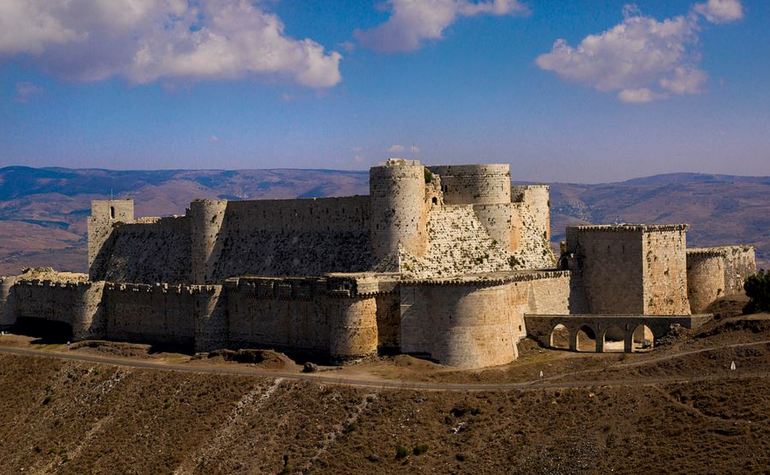
Krak des Chevaliers, Crusadercastle

Krak des Chevalier castle
Krak des Chevalier castle – Photo: E.Lafforgue (Flickr)
Krak des Chevaliers is regarded as being one of the best preserved Crusader castles in the world. It is located 65 km west of the city of Homs, close to the border of Lebanon.
  • Krak des Chevaliers was the headquarters of the Knights Hospitaller during the Crusades who were contemporaries of the Knights Templar. It was expanded between 1150 CE and 1250 CE and eventually housed a garrison of 2,000. The inner curtain wall is up to 100 feet thick at the base on the south side, with seven guard towers 30 feet in diameter
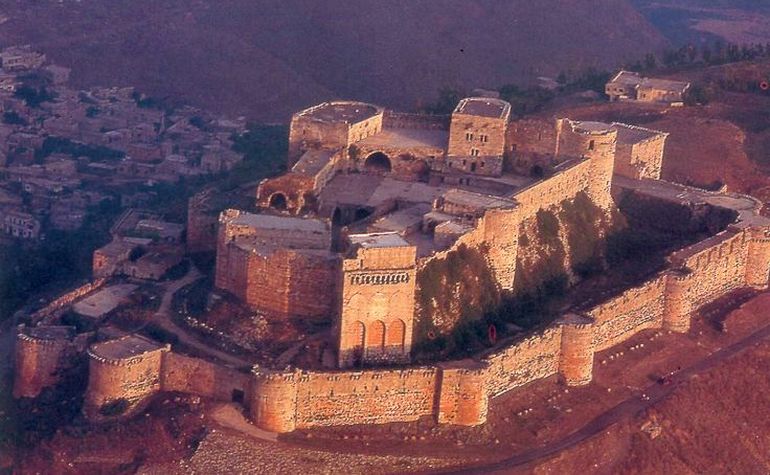
Aerial view of Krak des Chevalier castle
Aerial view of Krak des Chevalier castle – Photo: membres.multimania.fr
  • Salahuddin Ayyubi unsuccessfully besieged the castle in 1188 CE.
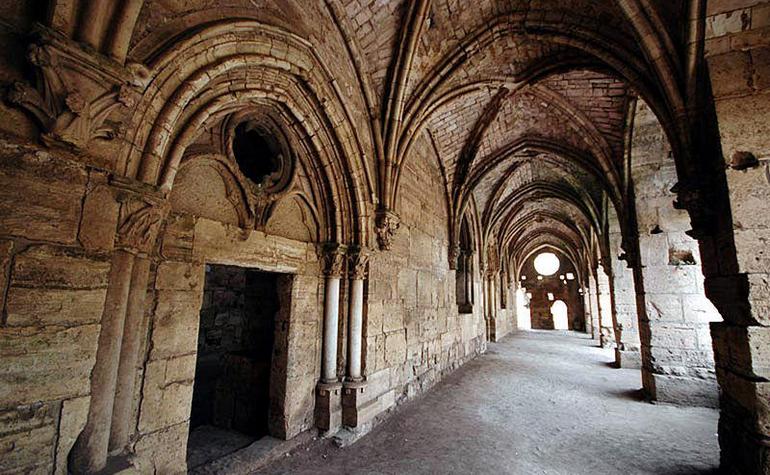
Inside Krak des Chevaliers castle
The hall of the Knights – Photo: turcanin.wordpress.com
  • In 1271 CE the fortress was captured by the Mameluke Sultan Baybars on April 8 with the aid of heavy catapults, at least one of which was later used to attack Acre in 1291 CE. Baybars refortified the castle and used it as a base against Tripoli. He also converted the Hospitaller chapel to a mosque (masjid).
References:  Wikipedia

Krak des Chevaliers from the southwes

Krak des Chevaliers overlooking the surrounding
area.

The area between the inner and outer walls is
narrow and was not used for accommodation.


Plan of Krak des Chevaliers from Guillaume Rey
Étude sur les monuments de l'architecture
militaire des croisés en Syrie et dans l'île de
Chypre (1871). North is on the right.

Tuesday, January 13, 2015

Tomb of Umar bin Abdul Aziz(Allah show mercy on him)

This is the tomb of Umar bin Abdul-Aziz, the eighth Umayyad Caliph who ruled from 99 to 101 A.H. Muslims historians agree that he was a just and devout ruler, compassionate, caring and beloved by his people. He was also a Tabiee (companion of the companions of the Holy Prophet).
  • Aslam (may Allah be pleased with him) narrates that he was once accompanying Umar bin Al-Khattab (may Allah be pleased with him) on his patrol of Madinah at night, it so happened that he leaned against a wall to rest when he felt tired. It was midnight, and we heard a woman say to her daughter, “O my daughter, get up and mix that milk with some water.”
    The girl said, “O mother, did you not hear the decree of Amir Al-Mu’minin (chief of the believers) today?”
    The mother said, “What was that?”
    The girl said, “He ordered someone to announce in a loud voice that milk should not be mixed with water.”
    The mother said, “Get up and mix the milk with water; you are in a place where Umar cannot see you.”
    The girl told her mother, “I cannot obey Him (Allah) in public and disobey Him in private.”
    Umar heard this, and told me: “O Aslam, go to that place and see who that girl is, and to whom she was speaking, and whether she has a husband.” So I went to that place, and I saw that she was unmarried, the other woman was her mother, and neither of them had a husband.
  • I came to Umar and told him what I had found out. He called his sons together, and said to them:“Do any of you need a wife, so I can arrange the marriage for you? If I had the desire to get married, I would have been the first one to marry this young woman.”
    Abdullah said: “I have a wife.” Abdur-Rahman said: “I have a wife.” ‘Asim said: “I do not have a wife, so let me marry her.” So Umar arranged for her to be married to ‘Asim. The woman gave birth to a daughter (named Fatima), who grew up to be the mother of Umar bin Abdul-Aziz.
  • Umar bin Abdul Aziz was extremely pious and disdainful of worldly luxuries. He preferred simplicity to the extravagance that had become a hallmark of the Umayyad lifestyle, depositing all assets and finery meant for the caliph into the public treasury. He abandoned the Khalifal palace and instead preferred to live in modest dwellings. He wore rough linens instead of royal robes, and often went unrecognized.
  • Though he had the people’s overwhelming support, he publicly encouraged them to elect someone else if they were not satisfied with him (an offer no one ever took him up on). Umar confiscated the estates seized by Umayyad officials and redistributed them to the people, while making it a personal goal to attend to the needs of every person in his empire. Fearful of being tempted into bribery, he rarely accepted gifts, and when he did he promptly deposited them in the public treasury. He even pressured his own wife – who had been daughter, sister and wife to three separate caliphs – to donate her jewelry to the public treasury.
  • While Umar’s reign was very short, he is very highly regarded in both Shi’a and Sunni Muslim memory. Indeed, he is considered one of the finest rulers in Muslim History, second only to the Four Rightly Guided Caliphs, and is affectionately referred to by some as the Fifth and last Rightly Guided Caliph.
  • According to most historians, Caliph Umar died in Aleppo, Syria, on the 5th or 6th of Rajab, 101 A.H. (some have mentioned the 20th) when he 39 or 40 years old. He was buried in Dair Siman in a plot purchased from a Christian.
  • The cause of his death is attributed to the reforms he initiated, which greatly angered the Umayyad nobility. It is reported that they bribed a slave of his to administer a deadly poison. The Caliph having felt the effect of the poison sent for the slave and asked him why he had poisoned him. The slave replied that he was given one thousand dinars for the purpose. The Caliph deposited the amount in the public Treasury and freeing the slave asked him to leave the place immediately, lest anyone should kill him.
  • He reportedly left behind only 17 dinars with a will that out of this amount the rent of the house in which he died and the price of the land in which he was buried would be paid.
References:  Abqari.com, Sifat Al-Safwah

Monday, January 12, 2015

Monastery of Bahira the monk

Monastery of Bahira the monk
Source: Arjeyempee (Flickr)
This ruin in Busra used to be the monastery of the Nestorian monk Bahira, who spotted the signs of Prophethood on the young Muhammad (peace and blessings of Allah be on him) while the Prophet was on a trade caravan on the way to Syria.
  • When Muhammad (peace and blessings of Allah be on him) was about 12 years old, he accompanied his uncle Abu Talib on a trade journey to Syria. In a place called Busra a very interesting incident took place, which caused Abu Talib to return Muhammad to Makkah.
  • On their trade journey they met a Christian monk by the name of Bahira, who lived a simple life in a monastery which contained ancient sacred texts that were not available anywhere else. Bahira had very simple provisions and lived a harsh life, surviving on the bare essentials. His diet was very simple and the clothes he wore were also coarse and well worn. He was looking outside and caught sight of a caravan approaching. His residence was on the main caravan route and he regularly saw caravans passing by, carrying different goods destined to be sold in the great markets of Syria.
  • He noticed that this caravan was different; there was something special about it. He decided to invite the people to a meal and find out more. Bahira sent a message to the caravan that his hospitality was extended to all the members of the caravan. The caravan traders accepted the invitation and arrived at the monk’s place.
  • When they arrived, Bahira searched their faces looking for something. He said that he had offered his hospitality to everyone, was there anyone left behind? They said that they had left a young boy called Muhammad to look after the camels. Bahira insisted that they send someone to get Muhammad and bring him to the entertainment. When Bahira saw the face of Muhammad he was delighted for he was aware from the scriptures of the arrival of a mighty prophet and he could see the signs on the young boy. He asked him a series of questions such as how he sleeps, what does he see when he sleeps, what he thinks about and what he does all day. The young Muhammad answered truthfully which convinced Bahira of who he is.
  • After the food, Bahira approached Abu Talib and asked him of his relationship to Muhammad. Abu Talib initially replied saying that he was his son upon which Bahira remarked that that could not be possible upon which Abu Talib confirmed that he was in fact his nephew. Bahira revealed to Abu Talib that Muhammad would be a great prophet one day. He said that when he had seen the caravan in the distance there was a cloud hanging over them, which was shading them from the great heat of the desert. When the caravan had stopped under a tree the cloud had also stopped above them.
  • Bahira said that he had seen the stones and the trees prostrating to Muhammad as he had been walking by. They only do this for a prophet of Allah. He looked at the Muhammad’s back and noticed the seal of the prophets, which was an oval shape protruding just below Muhammad’s shoulder blades. He said that this was one of the signs of a great prophet to come that was taught to them in their books.
  • Bahira said “This is the master of all humans, Allah will send him with a message which would be a mercy to all humans”. Bahira advised that Muhammad should be taken back to Makkah at once, if the Jews found out about Muhammad they would try to kill him. Abu Talib took the advice of this wise old monk and sent Muhammad back with some of the guides.
  • Accompanying Muhammad (peace and blessings of Allah be on him) on this trip was the young Abu Bakr and Bilal (may Allah be pleased with them) and they formed a deep bond which lasted right through their adult life.
References:  Musalla.org, Life of the Prophet (peace and blessings of Allah be on him) – Sh. Abdul Nasir Jangda


Saturday, January 10, 2015

Tomb of Habil , the son of Adam (uponhim be peace)

This is the tomb of Habil, the son of Adam (upon him be peace) and the first person to be murdered in the world. It is located on the outskirts of Damascus.
  • The Prophet Adam (upon him be peace) and Hawwa (Eve) were blessed with two sons, Habil (Abel) and Qabil (Cain). When they grew up, Habil, the younger brother, became a shepherd. He herded sheep, goats and other animals. The elder brother Qabil, worked as a farmer, tilling the fields.
  • One day both decided to make a sacrifice to please their Lord. Habil took the best of his flock, while Qabil brought his crops. Suddenly a spark of light came down and burnt Habil’s offering to ashes. Thus Allah (Glorified and Exalted is He) accepted Habil’s sacrifice, but rejected Qabil’s sacrifice. Qabil felt hurt at being disgraced and insulted. His face darkened with anger and his heart became hardened: “No,” cried Qabil, “I will kill you!” At this treat from his elder brother, Habil did not shout back. He just said calmly: ”Even if you raise your hand to kill me, I will not fight back, for I fear Allah, the Lord of the Worlds.”
  • But Qabil’s anger got the better of him and he killed his innocent brother Habil. But soon Qabil’s anger cooled down and he felt very sorry: ”Now I have killed my brother,” said Qabil to himself in deep sorrow. Then Allah sent a raven, which landed on the ground near the body. The raven began to scratch the ground to tell Qabil that he should bury his brother’s dead body under the earth. “Woe is me!” Cried Qabil helplessly. “I am worse even than this raven, for I cannot hide my brother’s dead body.” Qabil felt his meanness all the more so, because even a raven could teach him a lesson. Narrating the story of the two brothers, the Quran reminds us in Surah al Ma’idah:“If anyone killed a person – except as punishment for murder or other corruption in the land – it shall be looked upon as if he had killed all mankind. And whoever saved a human life, shall be looked upon as if he had saved all mankind.” [5:32]
References:  Stories from the Quran – Saniyasnain Khan


The Road To Habil's Shrin


Tomb of Habil


Habil Ibn Adam Mausoleum


Under This Type Of Tree Qabil Was Taught By
The Raven


The Tomb Of Habil Ibn Adam


Friday, January 9, 2015

Sayyiduna Imam al-Nawawi’s Maqam Destroyedin Nawa

The mausoleum of Imam Nawawi is in Nawa in
Deraa province near the Jordanian border. (Image
grab from YouTube video)
Source : english.alarabiya.net/en/News/middle-east/2015/01/08/Extremists-destroy-13th-century-Muslim-tomb-in-Syria.html


8 January 2015
Al- Qaeda- linked Nusra Front blows up 800 - year-
old mausoleum of leading Islamic scholar , Imam
Nawawi , in Deraa province .
The Syrian branch of al-Qaeda , the al- Nusra Front ,
has destroyed a 13th century tomb of a revered
Islamic scholar in southern Syria , a group
monitoring the violence has said .
The Syrian Observatory for Human Rights said on
Wednesday , the mausoleum of Imam Nawawi in
Nawa, near the Jordanian border, had been
destroyed by the armed group .
The Syrian government ' s Islamic endowments
ministry, which has lost control of much of Deraa
province to rebel groups , condemned the bombing
as an attack on the " country' s history and
heritage" .
In a report published in late December, the UN said
290 sites across the country had been directly
affected by fighting , of which 24 had been
destroyed , 104 severely damaged , 85 moderately
damaged and 77 possibly damaged .
Fighters belonging to the al-Qaeda affiliate and its
rival, the Islamic State of Iraq and the Levant
( ISIL) , regard the reverence of tombs as
tantamount to idolatry and have demolished
shrines.
Source : m.aljazeera.com/story/2015189829785527


Tuesday, January 6, 2015

Madressa of Ibn Kathir(Allah show mercy on him) ( ISLAMIC HERITAGE )

This is the madressa (seminary) of Ibn Kathir, the famous mufassir (commentator) of the Holy Quran. It is situated close to the monastery of Bahira.
  • His full name is Abu Al-Fida, ‘Imad Ad-Din Isma’il bin ‘Umar bin Kathir Al-Qurashi Al-Busrawi. He was born in 1301 CE in Busra, Syria (hence Al-Busrawi).
  • Upon completion of his studies he obtained his first official appointment in 1341, when he joined an inquisitorial commission formed to determine certain questions of heresy. Thereafter he received various semi-official appointments, culminating in 1366 with a professorial position at the Umayyad Mosque, Damascus. Ibn Kathir wrote a famous commentary on the Quran named ‘Tafsir ibn Kathir’ which linked certain Hadith, or sayings of the Prophet (peace and blessings of Allah be on him), and sayings of the Sahaba on verses of the Quran, in explanation. Tafsir Ibn Kathir is famous all over the Muslim world as one of the most widely used explanations of the Quran today.
  • Ibn Kathir was renowned for his great memory regarding the sayings of the Prophet (peace and blessings of Allah be on him) and the entire Quran. He is known as a qadi (judge), a master scholar of history, and a mufassir (Quran commentator). Ibn Kathir saw himself as a Shafi scholar, this is indicated by two of his books, one of which was Tabaqaat ah-Shafai’ah, or The Categories of the Followers of Imam Shafi.
  • In later life, he became blind. He attributes his blindness to working late at night on the Musnad of Ahmad Ibn Hanbal in an attempt to rearrange it topically rather than by narrator. He died in February 1373 in Damascus.
Famous writings of Ibn Kathir:
  • Tafsir ibn Kathir
  • The Beginning and the End (Arabic: Al Bidayah wa-Nihayah).
  • Al-Sira Al-Nabawiyya
  • Tabaqaat ah-Shafi’iah
  • Signs Before the Day of Judgement
  • Sins and their Punishments
  • Stories of The Prophets
References:  Ibnkathir.atspace.com, Wikipedia.

Sunday, January 4, 2015

Madressa of Nuruddin Zangi

Madressa of Nuruddin Zangi
External view of the Madressa – Photo: Wikipedia Commons
The Nuruddin madressa (seminary) is located around the Khayattin Souk, along the walled city of Damascus. It also includes a mosque (masjid) and the tomb of Nuruddin Zangi, a major Muslim commander who fought against the Second Crusade.
Tomb of Nuruddin Zangi
The tomb of Nuruddin Zangi – Photo: Wikimedia Commons
Reference:  Wikipedia


Friday, January 2, 2015

Tomb of Abu Darda(may Allah be pleased with him)

Tomb of Abu Darda ra
Photo: Onemilegrads.blogspot.com
This tomb in Damascus belongs to Abu Darda (may Allah be pleased with him), an eminent companion of the Prophet (peace and blessings of Allah be on him). His wife Umm al-Darda is also buried close to him.
The entrance to the tomb:
Entrance to tomb of Abu Darda ra
Photo: Girlsoloinarabia.typecast.com

Reference:  Wikipedia

Wednesday, December 31, 2014

Tomb of Bilal (may Allah be pleased with him)

This is the tomb of Bilal-bin-Rabah (may Allah be pleased with him), one of the best known of the galaxy of Sahabah as the Muezzin (caller to prayer) of the Prophet’s Masjid. It is located in the Bab al-Saghir cemetery in Damascus.
  • Bilal (may Allah be pleased with him) was an Abyssinian (Ethiopian) slave of a disbeliever in Makkah. His conversion to Islam was, naturally, not liked by his master and he was, therefore, persecuted mercilessly. Ummayah-bin-Khalaf, who was the worst enemy of Islam, would make him lie down on the burning sand at mid-day and would place a heavy stone on his breast, so that he could not even move a limb. He would then say to him, “Renounce Islam or swelter and die.”
  • Even under these afflictions, Bilal (may Allah be pleased with him) would exclaim: “Ahad” – The One (Allah), “Ahad” – The One (Allah).
  • He was whipped at night and, with the cuts thus received, made to lie on the burning ground during the day to make him either forsake Islam or to die a lingering death from wounds. The torturers would get tired and take turns (Abu Jahl, Ummayah and others) and vie with one another in afflicting more and more painful punishment, but Bilal (may Allah be pleased with him) would not yield. At last Abu Bakr (may Allah be pleased with him) bought his freedom, and he became a free Muslim.
  • Allah (Glorified and Exalted is He) rewarded his steadfastness. He was to have the honour of becoming the Prophet’s Muezzin. He was to always remain with him at home and abroad to call out the Azaan for his Salat. After the Prophet’s death it became very hard for him to continue his stay in Madinah where he would miss him at every step and in every corner. He therefore left Madinah, and decided to pass the rest of his life striving in the path of Allah. Once he beheld the Prophet (peace and blessings of Allah be on him) in his dream saying to him:“O Bilal! How is it that you never visit me?” 
  • No sooner did he get up that he set out for Madinah. On reaching there, Hassan and Hussain (may Allah be pleased with them), the Prophet’s grandsons, requested him to call out the Azaan. He could not refuse them, for they were very dear to him. But as soon as the Azaan was called, the people of Madinah cried openly out of their anguish at the memory of the happy old days of the Prophet’s time. Even the women came out of their houses weeping. Bilal (may Allah be pleased with him) left Madinah again after a few days and died in Damascus in 20 A.H.


The Tomb Of Bilal-bin-Rabah (may Allah
be pleased with him)

Entrance To The Mausoleum


The Brief Writing About Bilal-bin-Rabah (may Allah
be pleased with him)

Tuesday, December 30, 2014

Bab al-Saghir cemetery

The Bab al-Saghir cemetery is situated close to the Umayyad Mosque and contains the graves of several eminent Sahabah (companions of the Prophet (peace and blessings of Allah be on him)) and pious predecessors.
These are some of the personalities said to be buried here. This is based on knowledge passed down and has not been independently verified, Allah (Glorified and Exalted is He) knows best:
  • Umm Kulthum, daughter of Ali (may Allah be pleased with him) and Fatima (may Allah be pleased with her)
  • Bilal-bin-Rabah, the Muezzin (caller to prayer) of the Prophet (peace and blessings of Allah be on him)
  • Muawiyah (may Allah be pleased with him)
  • Tomb of Fidha, the maid of Fatima (may Allah be pleased with her), the daughter of the Prophet (peace and blessings of Allah be on him)
  • Asma, wife of Jafar Tayyar (may Allah be pleased with him)
  • Kamaid bin Aswad al-Kindi, companion of Ali (may Allah be pleased with him)
  • Tomb of Obay ibn Ka’b (may Allah be pleased with him), husband of Halima, nursing mother of the Prophet (peace and blessings of Allah be on him)
Note that the tombs of two of the wives of the Prophet (peace and blessings of Allah be on him),Umm Salama and Ramlah bint Abi-Sufyan (aka Umm Habeebah) are present here but it is highly doubtful that they contain the actual bodies. The structures were likely to have been created to encourage ziyarat to the area. The vast majority of scholars are of the opinion that they are buried in Jannatul-Baqi in Madinah, along with most of the remaining wives (Ummahatul Mu’mineen) of the Prophet (peace and blessings of Allah be on him).

References:  Local guide, Wikipedia.


The Bab al-Saghir cemetery, late 19th c.
Source : riowang.blogspot.in/2010/09/damascus-anno.html


The Bab al-Saghir Cemetery of Damascus in
1943, famous for being the final resting place for
the Prophet Mohammad's wives and companions
Source : www.syrianhistory.com/en/photos/2978