Showing posts with label Christians heritage museum. Show all posts

Saturday, December 6, 2014

Shrine of Yahya (upon him be peace)

Shrine of Yahya as
The Shrine inside the prayer hall of the Umayyad Mosque – Photo: londoncosmopolitan.blogspot.com


Legend has it that this small structure within the Umayyad Mosque houses the head of Yahya (upon him be peace) (John the Baptist). The head was supposedly found during excavations for the building of the mosque.
  • Yahya (upon him be peace) is mentioned by name 5 times in the Holy Quran. He is the only Prophet whose name was chosen for him exclusively by Allah (Glorified and Exalted is He).
  • The Prophet Zakariyyah (upon him be peace) used to go to the temple daily (the current al-Aqsa Sanctuary) to deliver his sermons even though he had grown feeble with age. He was not a rich man, but he was always ready to help those in need. His one disappointment in life was that he had no children, for his wife was barren. This worried him, for he feared there was no one after him to carry out his work. The people needed a strong leader, for it they were left on their own, they would move away from Allah’s teachings and change the Holy Laws to suit themselves.
  • During one of his visits to the temple, he went to check on Maryam (upon him be peace) [Mary], who was living in a secluded room of the temple. He was surprised to find fresh out of season fruit in her room. Besides him, no one had entry to her room. When he inquired, she told him that the fruit was from Allah which she found every morning. But why was he so surprised, she asked him. Did he not know that Allah provides without measure for whom He wills? This noble girl had opened his eyes to a startling idea. Could he not ask his Lord to bless him with a child in his old age? Even though his wife was past childbearing age, nothing was impossible for Allah (Glorified and Exalted is He).
  • Allah (Glorified and Exalted is He) revealed in the Holy Quran in Surah Maryam:
    “Kaf, Ha, Ya, Ain, Sad, (These letters are one of the miracles of the Quran, and none but Allah Alone knows their meanings). This is a mention of the Mercy of your Lord to His slave Zakariyyah. When he called out his Lord (Allah) – a call in secret, saying: “My Lord! Indeed my bones have grown feeble, and gray hair has spread on my head, and I have never been unblest in my invocation to You, O my Lord! And Verily! I fear my relatives after me, since my wife is barren. So give me from Yourself an heir, – who shall inherit me, and inherit also the posterity of Yaqoob [Jacob] (inheritance of the religious knowledge and Prophethood, not the wealth, etc.) And make him, my Lord, one with whom You are Well-pleased!“ 
  • Allah said: “O Zakariyyah! Verily, We give you the glad tidings of a son. His name will be Yahya (John). We have given that name to none before him.“ [19:1-7]
  • The name Yahya literally means ‘he lives’. Qatadah (may Allah show mercy on him) says this name was given to him because Allah had given him the inner life through Iman and Nubuwwah (i.e. belief and prophethood). Some say it was because Allah (Glorified and Exalted is He) brought people to life by guiding them through Yahya (upon him be peace). Yet others have said it was due to his mother’s womb being brought back to life after being barren until old age.
  • Yahya (upon him be peace) was born six months before Isa (upon him be peace). His mother was the sister of Hanna, who was the mother of Maryam (upon her be peace). When supplicating for a child Zakariyyah had specifically asked for a ‘pure child’ (Quran 3:38). According to his wishes, Allah (Glorified and Exalted is He) granted him an extraordinary son.
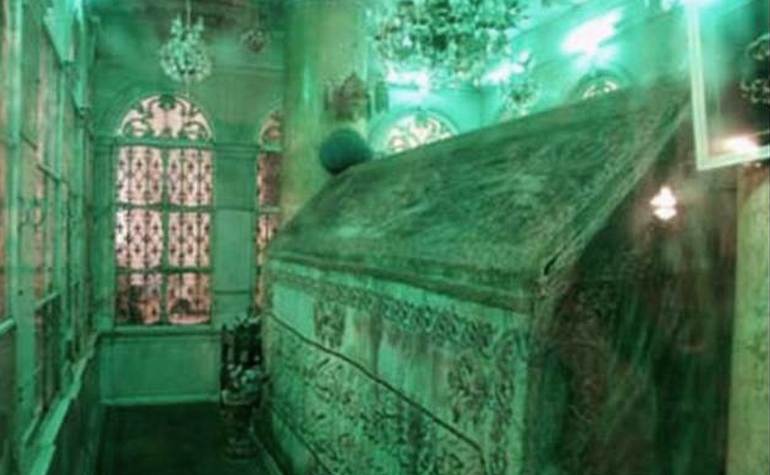
Interior of the tomb of Yahya as
A view of the interior of the tomb
  • In infancy, Yahya (upon him be peace) was instructed by Allah (Glorified and Exalted is He) to adhere and abide to the teachings of the Torah. He was also given the duty of propagating and communicating it to the people. Allah (Glorified and Exalted is He) granted him tremendous maturity and wisdom while he was still a child, and according to some historians, he was endowed with prophethood before the age of thirty.
  • Yahya (upon him be peace) preferred solitude to company. He ate leaves of trees and sometimes locusts or grasshoppers and drank the water of springs. He wept much from the fear of Allah and was the epitome of chastity, remaining unmarried throughout his life.
  • A conflict took place between Yahya (upon him be peace) and the authorities at that time. A tyrant king, Herod Antipas, the ruler of Palestine, was in love with Salome, his brother’s daughter. He was planning to marry his beautiful niece. The marriage was encouraged by her mother and by some of the learned men of Zion, either out of fear or to gain favour with the ruler. On hearing the ruler’s plan, Yahya (upon him be peace) pronounced that such a marriage would be incestuous. He would not approve it under any circumstance, as it was against the Law of the Torah.
  • Yahya (upon him be peace)’s pronouncement spread like wildfire. Salome was angry, for it was her ambition to rule the kingdom with her uncle. She plotted to achieve her aim. Dressing attractively, she sang and danced before her uncle, arousing Herod’s lust. Embracing her, he offered to fulfill whatever she desired. At once she told him: “I would love to have the head of Yahya, because he has defiled your honour and mine throughout the land. If you grant me this wish, I shall be very happy and will offer myself to you.” Bewitched by her charm, he submitted to her monstrous request. Yahya (upon him be peace) was executed and his head was brought to Salome. The cruel woman gloated with delight. But the death of Allah’s beloved prophet was avenged. Not only she, but all the children of Israel were severely punished by invading armies which destroyed their kingdom. According to Biblical sources, Yahya (upon him be peace) died in the year 36 CE aged 42.


References: Atlas of the Quran – Dr. Shauqi Abu Khalili, Stories of the Prophets – Ibn Kathir, HUMA Travel guide to Palestine.


Friday, December 5, 2014

Minaret of Prophet Isa (upon him be peace)


Minaret of Isa as
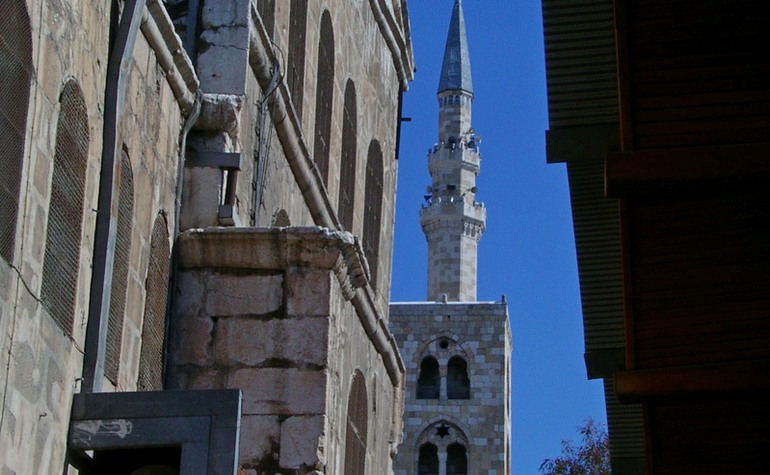
The minaret viewed from the rear of the Umayyad Mosque – Photo: R.Chohan
This minaret, which is on the left side of the Umayyad Mosque is also known as the Jesus minaret. It is from here that Hazrat Isa (upon him be peace) will descend back to earth towards the end of time.
  • Muslims believe that Isa (upon him be peace) did not die on the cross but Allah (Glorified and Exalted is He) raised him to heaven and he will return one day to defeat the Dajjal (Anti-Christ). According to a Hadith, he is on the second heaven. The Prophet (peace and blessings of Allah be on him) mentioned, “During the Me’raj (Ascension), I met Isa (upon him be peace) on the second heaven. I found him of medium stature, reddish white. His body was so clean and clear, that it appeared as though he had just performed ghusal (ablution, cleansing of the entire body) and come.”
  • In another Hadith, the Prophet (peace and blessings of Allah be on him) mentioned, “Allah will send Maseeh ibne Maryam (Messiah son of Mary). Thus he will descend near the white eastern minaret of Damascus, clad in two yellow sheets, leaning on the shoulders of two angels.” [Sahih Muslim]
Aerial view of the Umayyad Mosque
Aerial view of the Umayyad Mosque – Photo: akg-images.de
  • The physical features of Isa (upon him be peace): He will resemble the famous sahabi Urwa bin Masoodi (may Allah be pleased with him). He will be of average height and red and white in colour. His hair will be spread to the shoulders, straight, neat and shining as after a bath. On bending his head, it will seem as if pearls are falling. He will have armour on his body. He will be wearing two pieces of cloth light yellow in colour.
  • He will descend on a Jamaat (group) that will be righteous at the time and comprising of 800 men and 400 women. The people will be preparing for war at the time against Dajjal. It will be time for Fajr prayers, and Imam Mahdi will be the Amir (leader) of the Muslims. From the darkness of the dawn, a sound will suddenly be heard that “one who listens to your pleas has come” – the righteous people will look everywhere and their eyes will fall on Isa (upon him be peace). Briefly, at the time of Fajr, Isa (upon him be peace) will descend. When descending, Isa (upon him be peace)’s hands will be on the shoulders of two angels (according to another source (Kab Abrar), a cloud will carry him). On their insistence Isa (upon him be peace) will introduce himself. He will inquire about their enthusiasm and thoughts on Jihad against Dajjal. Isa (upon him be peace) will descend on the eastern side near the minaret in Damascus (or in Baitul-Muqaddus according to another narration). At the time Imam Mahdi will have proceeded forward to lead the Fajr Salaat. The Iqamat of the Salaat will already have been recited and Imam Mahdi will call Isa (upon him be peace) for Imamat (to lead the prayer), but he (Isa (upon him be peace)) will instead tell Imam Mahdi to lead the prayer since the Iqamat of that Salaat has already been said for him. Thus Imam Mahdi will lead the prayer, and Isa (upon him be peace) will follow him. After the ruku, he will make this statement: “Allah has killed Dajjal and the Muslims have appeared.”
  • Isa (upon him be peace) will subsequently kill Dajjal and a great era of peace and harmony will come to the world. Isa (upon him be peace) will marry and have children and will live for 19 years after his marriage. He will then pass away and be buried next to the Prophet (peace and blessings of Allah be on him) in Majid-e-Nabwi, Madinah.

References:  Major signs of Qiyamat – Mufti A.H.Elias


Thursday, December 4, 2014

Umayyad Mosque

Umayyad Mosque exterior
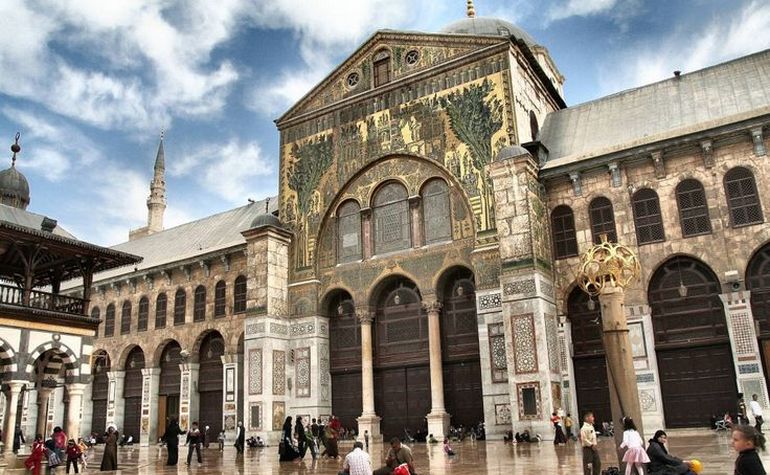
Exterior of the Umayyad Mosque – Photo: gmiah.hubpages.com
The Umayyad Mosque (or Masjid), also known as the Grand Mosque of Damascus is one of the largest and oldest mosques in the world. It is the first monumental work of architecture in Islamic history.

  • The spot where the mosque now stands was originally a temple dedicated to the idol Hadad in the Aramaean era about 3000 years ago. When the Romans ruled Damascus a temple was built for the worship of Jupiter. It then became a Christian church dedicated to John the Baptist in the Byzantine era towards the end of the fourth century.
  • Following the Battle of Yarmouk in 636 CE, Damascus was conquered by the Muslims under the leadership of Khalid-bin-Waleed (may Allah be pleased with him). The Muslims shared the church building with the Christians for worship. The Muslims prayed in the eastern section of the structure and the Christians in the western side.
Prayer hall of the Umayyad Mosque
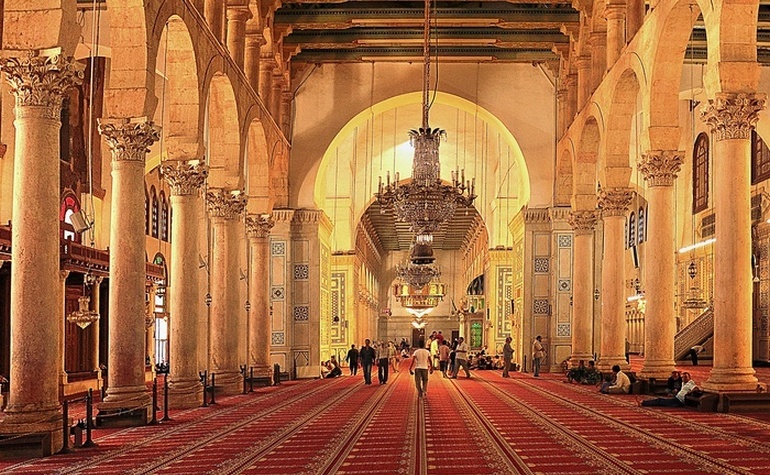
Prayer hall of the Umayyad Mosque – Photo: A. Shamandour
  • This collective use continued until the reign of the Umayyad caliph al-Walid I, when the prayer space became inadequate both in terms of capacity and the need for an architectural monument to represent the new religion. The caliph negotiated with Christian leaders to take over the space, and in return al-Walid promised that all the other churches around the city would be safe, with the addition of a new church dedicated to the Virgin granted to the Christians as compensation. The church was purchased from the Christians before being demolished and between 706 and 715 CE the current mosque was built in its place.
  • Construction of the mosque was based on the mosque of the Prophet Muhammad (peace and blessings of Allah be on him) in Madinah, which had many functions: it was a place for personal and collective prayer, religious education, political meetings, administration of justice, and relief of the ill and homeless. The caliph asked and obtained from the Emperor of the Byzantine Empire for 200 skilled workers to decorate the mosque, as evidenced by the partly Byzantine style of the building. The new mosque was the most impressive in the Islamic world at the time, and the interior walls were covered with fine mosaics. The building became one of the marvels of the world, because it was one of the largest of its time. The exterior walls were based on the walls of the temple of Jupiter and measure 100 by 157.5 m.
  • The Umayyad Mosque holds special significance to Shi‘ah Muslims, as this was the destination of the descendents of the Prophet (peace and blessings of Allah be on him), made to walk here from Iraq, following the battle of Karbala.
  • The prayer hall consists of three aisles, supported by columns in the Corinthian order. It was one of the first mosques (the other being al-Aqsa Mosque in Jerusalem) to have such a shape and in this way, the visitors could see the mihrab, the alcove indicating the direction of Makkah, and each other more easily.
Ummayad mosque mimbar and mihrab
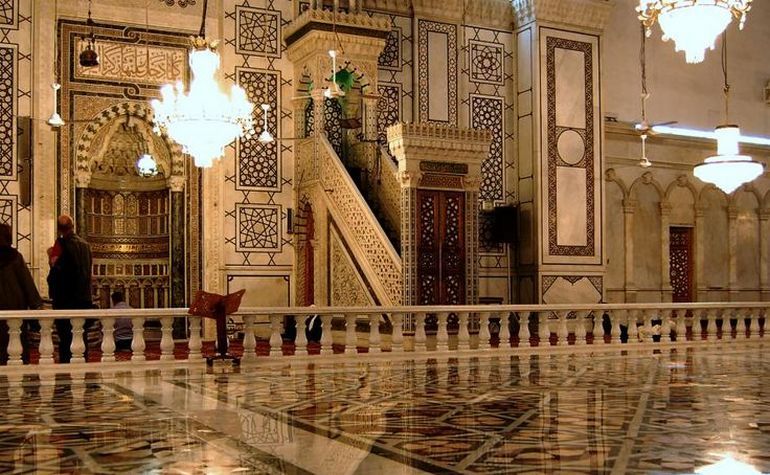
The mimbar (pulpit) and mihrab (prayer niche) – Photo: afghan.delcity91.com
  • In 2001 Pope John Paul II visited the mosque, primarily to visit the relics of John the Baptist. It was the first time a pope had paid a visit to a mosque.

References:  Wikipedia, Archnet.org