Showing posts with label makkah other. Show all posts

Monday, August 1, 2016

Jahiliyyah cemetery


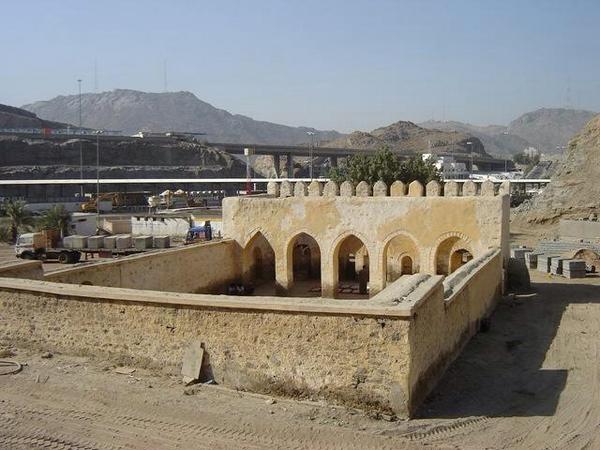
This area, in a district south-west of the Haram, is where prior to the advent of Islam some of the pagan Arabs used to bury their daughters alive as they believed them to be a sign of disgrace. It is also believed that Sumayyah (may Allah be pleased with her) is buried here; she was the first person to be martyred in the cause of Islam.

(more to follow)

References:  Local Makkan guide

Sunday, July 31, 2016

Masjid Ra’yah

Majid Ra’yah (masjid of the flag) is located on the spot where the Prophet (peace and blessings of Allah be on him) had his flag planted when he conquered Makkah. It is also known as Masjid Jowdariyyah.

(more to follow)

References:  The History of Makkah Mukarramah – Dr. Muhammad Ilyas Abdul Ghani

Sunday, May 22, 2016

Valley of Abu Talib

MUSEUM


This is the valley of Abu Talib (She’eb Abi Talib), where the members of Banu Hashim and Banu Al-Muttalib (Muslims and non-Muslims) were forced to withdraw from Makkah and live here in a painful boycott for three years.
  • When Islam began to spread the Makkans asked Abu Talib, the uncle and protector of the Prophet (peace and blessings of Allah be on him), to hand him over to them for execution but he steadfastly refused. Abu Talib acted fast and called on the members of Banu Hashim and Banu al-Muttalib to meet at the Ka’bah and convinced them to pledge that they would protect their clansman, Muhammad (peace and blessings of Allah be on him). Abu Lahab, another of the Prophet’s uncles and self-proclaimed sworn enemy, refused to take the pledge and declared he was on the side of the Quraysh.
  • The Quraysh held a meeting and decided to outcast the Banu Hashim and Banu al-Muttalib by placing them under a total social boycott. The other clans from the Quraysh would not marry their daughters, transact business with them, keep company with them, nor would they accept any peace overtures from these two clans until they handed over the Prophet (peace and blessings of Allah be on him). Once all the people present had agreed with the points mentioned above, Baghid bin Amir bin Hashim put this pact in writing. The Quraysh chiefs signed this document and the parchment was hung in the Ka’bah in order to give it authority. This was done on the 1st Muharram, in the seventh year of the Prophet’s (peace and blessings of Allah be on him) mission. When the deed was done, Baghid’s hand, or at least some of his fingers, became paralyzed.
  • The Prophet (peace and blessings of Allah be on him), along with Abu Talib and clan members of Banu Hashim and Banu al-Muttalib were forced to withdraw from Makkah and live in She’eb Abi Talib, which was a subsection of one of the gorges that ran down to Makkah.
  • The boycott was devastating and for many months they lived in misery. It was so rigorously applied and food was so scarce that they had to eat the leaves of trees. The women, and more specially the children and suckling babies would cry with hunger which could be heard all over the valley. The Quraysh told the merchants not to sell any goods to them. Prices were increased to prevent them from buying even essentials. They remained in that state for three years. Apart from some kind Qurayshi people who secretly sent food to them they were totally abandoned. Despite such grim circumstances, the Prophet (peace and blessings of Allah be on him) never ceased inviting non-Muslims to Islam. He was particularly active during the time of Hajj. It was at this time that he would speak to tribes that had travelled to Makkah from all over the Arab world.
  • A group of fair-minded Quraysh, led by Hisham ibn ‘Amr, hated this unfair boycott. Hisham was highly respected among his people. He contacted some men of the Quraysh whom he knew to be kind-hearted and considerate. He told them it was shameful to allow such tyranny to continue and asked them to abandon the unjust contract. When he had persuaded five men to agree, they met together to work towards this end. When the Quraysh were assembled the next day, Zuhayr ibn Abi Umayyah, whose mother was the aunt of the Prophet (peace and blessings of Allah be on him), faced the people and demanded, “People of Makkah! Do we eat and clothe ourselves while the Banu Hashim are perishing, unable to buy or sell? By Allah, I will not sit down until this unjust document is torn up!”
  • Abu Jahal became suspicious of the sudden rebellion but Abu Talib saw his opportunity to step in. He had come into the precincts of Ka’bah to tell the Quraysh that the Prophet (peace and blessings of Allah be on him) had received a revelation about the fate of the wicked parchment. He stood up, and facing the Quraysh, told them that Allah had revealed to the Prophet (peace and blessings of Allah be on him) that termites had eaten the parchment inside the Ka’bah. The only thing that remained of the document, Abu Talib said, were the words “In Your Name, O Allah.” Abu Talib then challenged the Quraysh, saying that if the Prophet’s claim turned out to be false, he would no longer stand between them and the Prophet (peace and blessings of Allah be on him). However, if the Prophet had spoken the truth, the Quraysh should end the boycott. The Quraysh accepted Abu Talib’s challenge.
     
  • When Mut’im bin Adiy rose to retrieve the parchment, the assembly saw that it had been destroyed. Its only remaining words were “Bismika Allahumma” (In Your Name, O Allah) and Allah’s name. Allah (Glorified and Exalted is He) had given the Quraysh yet another sign but once again they refused to admit their error and accept Islam. Their only concession was to end the boycott. The Prophet (peace and blessings of Allah be on him) and his Companions came out of the mountain pass and were allowed to live in Makkah once again.
References:  When the Moon Split – Shaikh Safiur-Rahman Mubarakpuri, Fazail-e-Aamal – Sheik Zakariyya Kandhalvi, Muhammad the last Prophet – Sayyed Abul Hasan Ali Nadwi
MUSEUM

Saturday, May 21, 2016

Mount Abu Qubais

MUSEUM
Mount Abu Qubays
The present structures built on top of Mount Abu Qubais
This large structure, adjacent to Mount Safa, is built on top of Mount Abu Qubais. It is believed that it was from the top of this mountain that the Prophet (peace and blessings of Allah be on him) pointed to the moon and split it into half.
Other than the above there are additional reasons why Mount Abu Qubais has great significance in our Islamic history:
  • It was the first mountain created by Allah (Glorified and Exalted is He).
  • According to at-Tabari, Prophet Adam (peace be upon him) died at the foot of Mount Abu Qubais and was subsequently buried there.
  • The Hajar al-Aswad (The Black Stone) was protected in it when Allah (Glorified and Exalted is He) sent the flood in the time of Prophet Nuh (peace be upon him).
  • The Umayyad governor Hajjaj bin Yusuf fired a catapult from the top of Mount Abu Qubais onto the Ka’bah during the seige of Makkah in 691 CE. This resulted in the killing of Abdullah bin Zubair (may Allah be pleased with him). 
a small white masjid on the top of hill
named MASJID BILAL---where the prophet Muhammad sallalla ho allihi wasalam showed the
miracle of bifercating moon into two parts--- .This masjid no more here. Beautiful palace of king
has been built here and this spot has come in the palace

Mount Qabees -Makkah
This tunnel is passing through mount of Qubais 


Another view of qubais mount .it is old pic . masjid-e-bilal is visible.
on the top of mountain in white colour. This mosque is no more  here


References:  Atlas of the Qur’an – Dr. Shauqi Abu Khalil, AlMiskeenah.com, Local Makkan guide., islamiclandmarks , ahlanpk
MUSEUM

Friday, May 20, 2016

House of Abu Bakr (may Allah be pleased with him)


This is the approximate place where the house of Abu Bakr (may Allah be pleased with him) was located in Makkah and from where Hijrah to Madinah commenced. It is in the Makkah Towers Hotel block, where a masjid (Masjid Abu Bakr) has been built on the 4th floor.
  • When the decision to assassinate the Prophet (peace and blessings of Allah be on him) had been made by the Quraysh, Jibraeel (upon him be peace) was sent down to the Prophet (peace and blessings of Allah be on him) to reveal to him the plot and to give him his Lord’s permission to leave Makkah.
  • Having been given the command for migration, the Prophet (peace and blessings of Allah be on him) called at the house of Abu Bakr (may Allah be pleased with him) at noon when the burning sun had forced the people indoors. Since it was an unusual time to visit, Abu Bakr (may Allah be pleased with him) speculated that migration must have been ordered. First of all he (peace and blessings of Allah be on him) inquired if there was any strange person in the house. When he was informed that there was no one in the house except Abu Bakr (may Allah be pleased with him) and his daughters, Asma and Aisha (may Allah be pleased with them), he disclosed that migration to Madinah had indeed been ordered. “Who will accompany you on the journey?” Abu Bakr (may Allah be pleased with him) asked. The Prophet (peace and blessings of Allah be on him) said, “You will accompany me.” Having heard this, tears of joy trickled down from the eyes of Abu Bakr (may Allah be pleased with him) and he said, “O Prophet of Allah! I have already bought two she-camels for this purpose and have made them strong and stout, and I offer you one.” The Prophet (peace and blessings of Allah be on him) said, “I will purchase it.” Thus he paid for it and Abu Bakr (may Allah be pleased with him) had to accept it. And from that moment, preparations for migration started. Asma (may Allah be pleased with her) made them provisions of parched barley and some other food, Aisha (may Allah be pleased with her) was at that time still of a very tender age. After telling Abu Bakr (may Allah be pleased with him) of the plan, the Prophet (peace and blessings of Allah be on him) went back to his home.
  • That night, the Prophet (peace and blessings of Allah be on him) slipped past the assassins surrounding his house and made his way to the house of Abu Bakr (may Allah be pleased with him). The two of them left Makkah hastily before the beginning of Fajr salah. Abdullah, the son of Abu Bakr (may Allah be pleased with him) also accompanied them as they first journeyed to Jabal Thawr.
  • When the Quraysh disbelievers realized they had been deceived and the Prophet (peace and blessings of Allah be on him) had escaped, they called at the house of Abu Bakr (may Allah be pleased with him) and knocked at the door. Asma (may Allah be pleased with her) came out. Abu Jahal angrily asked, “O girl! Where is your father?”. She flatly replied, “I know nothing about him.”Hearing this Abu Jahal slapped her so violently that her earrings fell down on the ground.
  • When Abu Bakr (may Allah be pleased with him) emigrated to Madinah in the company of the Prophet (peace and blessings of Allah be on him), he took with him all his money, thinking that the Prophet might need it. It was approximately 6,000 dirhams. After the departure, his father Abu Qahafah (who was blind and who had not till then accepted Islam) came to express his sympathy to his grandaughters.
  • Asma (may Allah be pleased with her) says: “Our grandfather came to us and said, ‘Your father has shocked you with his migration to Madinah, and seems to have put you to further hardship by taking all his money with him.’ I said, ‘No grandfather, do not worry. He has left a lot of money for us.’ I collected some pebbles and deposited them in the recess where my father used to keep his money and covered it with a cloth. I then took my grandfather to the place and placed his hand over the cloth. He thought that the recess was really full of dirhams. He remarked: ‘It is good that he has left something for you to live on.’ By Allah, my father had not left a single dirham for us, I played this trick simply to pacify my grandfather.” This was the spirit of self-sacrifice imbued in the Muslims of that time.
  • The Prophet (peace and blessings of Allah be on him) once said, “Nobody’s wealth has benefited me so much as that of Abu Bakr (may Allah be pleased with him). I have compensated everybody for the good done to me, except Abu Bakr. He shall be compensated by Allah Himself.”
References:  Local Makkan guide, Fazail-e-Aamal – Sheik Zakariyya Kandhalvi, The History of Islam – Akbar Shah Najeebabadi

Tuesday, May 10, 2016

Makkah: OtherBirthplace of the Prophet (peace and blessings of Allah be on him)


Birthplace of the Prophet (peace and blessings of Allah be on him)
The present library located in the birthplace of the Prophet (peace and blessings of Allah be on him)
This library, in She’eb Banu Hashim in Makkah is sited on the place where the Prophet (peace and blessings of Allah be on him) was born on Monday 12 Rabi’ al-Awwal (April 22, 571 CE), in the Year of the Elephant. His ancestry can be traced back to the Prophet Ebrahim (upon him be peace).
  • The Prophet’s (peace and blessings of Allah be on him) father Abdullah died about six months before his birth. He had gone on a trading expedition to Gaza and Syria in the north and on the way back he had lodged with his grandmother’s family in Yathrib (later to be known as Madinah). He became ill, died and was buried there. Thus, the Prophet (peace and blessings of Allah be on him) was born an orphan.
  • While his mother Aminah was pregnant, she had a dream that a light was emitted from her lower body that illuminated the palaces of Syria. When she went into labour, Shifa bint Amr, the mother of Abdul Rahman bin Auf (may Allah be pleased with her) served as midwife. Abdul Muttalib received the news of his grandson’s birth with joy. He took the newborn to the Ka’bah and invoked Allah’s blessings and thanks. Believing his grandson would grow up to be highly praised, Abdul Muttalib named him Muhammad, which means ‘he who is praised’. In keeping with Arab tradition, he then shaved the baby’s head and afterwards invited his fellow Makkans to a feast.
  • According to the report of Abul-Fida, when the people asked Abdul Muttalib as to why he called his grandson Muhammad, preferring it to the names of his forefathers, he replied, “It is because I have a longing that my grandson should be praised and commended by one and all in the world.”
  • Muhammad (peace and blessings of Allah be on him) was first nursed by his mother, and then by Umm Ayman, his father’s slave. An Abyssinian (Ethiopian) whose real name was Barakah, she embraced Islam and migrated to Madinah, where she died six months after the Prophet’s death. Barakah (may Allah be pleased with her) thus had the distinction of being the person who knew the Prophet (peace and blessings of Allah be on him) for the longest period of time.
  • Thuwaybah, the slave of Muhammad (peace and blessings of Allah be on him)’s uncle Abu Lahab, also nursed the infant. At that time, Thuwaybah was also nursing her own child, Masrooh, as well as Hamzah bin Abdul Muttalib and Abu Salamah bin Abdul Makhzoomi. Hence, these men became foster brothers because they were nursed at the same breast. Thuwaybah suckled the Prophet (peace and blessings of Allah be on him) for seven days and on the eighth day he was entrusted to Haleemah of the Banu Sa’d clan to bring him up in the desert.
  • Certain miraculous events are reported to have occurred at the time the Prophet (peace and blessings of Allah be on him) was born. However, most of them are not authentically related and therefore cannot be relied upon as decisive proof. This includes the narration which relates that some of the galleries of Kisraa’s (the Persian King’s) palace broke-up and collapsed, that the sacred-fire of the Magians, which had been burning for 1000 years in the Temple of Fars died-out and that some of the churches on Lake Saawah (in Syria) collapsed and sank down.
  • However, it is authentically related that the Prophet (peace and blessings of Allah be on him) said.“I am a result of the supplication of my father Ebrahim (upon him be peace) and the glad-tidings brought by Isa (upon him be peace). And my mother – when she bore me – saw that a light shone out from her, which lit up the palaces in Syria.” [al-Haakim]
  • Photos of the interior of the library:
Interior of the library (1) - Photo: 3DMekanlar.com
Interior of the library (1) – Photo: 3DMekanlar.com
Interior of the library (2) - Photo: 3DMekanlar.com
Interior of the library (2) – Photo: 3DMekanlar.com
Interior of the library (3) - Photo: 3DMekanlar.com
Interior of the library (3) – Photo: 3DMekanlar.com
Interior of the library (4) - Photo: 3DMekanlar.com
Interior of the library (4) – Photo: 3DMekanlar.com

Saturday, March 26, 2016

Masjid Aisha


Masjid Aisha, also known as Masjid at-Tan’eem marks the place where Ummul-Mu’mineen Aisha (may Allah be pleased with her) went to enter into Ihram for Umrah when the Prophet (peace and blessings of Allah be on him) told her to do so during the farewell Hajj. The masjid lies 7.5 km south from Makkah on the road to Madinah and is the closest of all the boundary points.

  • Jaabir (may Allah be pleased with him) reports that because Aisha (may Allah be pleased with her) was experiencing menstrual cycle the Prophet (peace and blessings of Allah be on him) instructed her to perform all the various rites of Hajj except for the tawaf. She then performed the tawaaf after her cycle had ended. She then said, “O Rasulullah (peace and blessings of Allah be on him)! While you have performed Hajj and Umrah, I have performed only Hajj.” The Prophet (peace and blessings of Allah be on him) then instructed her brother Abdur-Rahman (may Allah be pleased with him) to take her to Tan’eem and it was from there that she performed her Umrah after her Hajj during the month of Dhul Hijjah.

References:  The History of Makkah Mukarramah – Dr. Muhammad Ilyas Abdul Ghani, Holy Makkah – Shaikh Safiur-Rahman Mubarakpuri , islamiclandmarks.com

Saturday, December 26, 2015

Masjid Nimrah/Waadi Urana


The masjid above is Masjid Nimrah and is located on the plain of Arafat. When the Prophet (peace and blessings of Allah be on him) was at Arafat on his farewell Hajj on the ninth day of Dhul Hijjah 10 AH (632 CE) he camped here. After midday he delivered his famous sermon (reproduced below) at Waadi Urana nearby while seated on his camel, after which he led the salah. More than 100,000 Sahabah accompanied him on this Hajj.
  • After praising, and thanking Allah the Prophet (peace and blessings of Allah be on him) said: “O People, lend me an attentive ear, for I know not whether after this year, I shall ever be amongst you again. Therefore listen to what I am saying to you very carefully and take these words to those who could not be present today. O People, just as you regard this month, this day, this city as Sacred, so regard the life and property of every Muslim as a sacred trust. Return the goods entrusted to you to their rightful owners. Hurt no one so that no one may hurt you. Remember that you will indeed meet your Lord, and that He will indeed reckon your deeds. Allah has forbidden you to take usury (interest), therefore all interest obligation shall henceforth be waived. Your capital, however, is yours to keep. You will neither inflict nor suffer any inequity. Allah has judged that there shall be no interest and that all the interest due to Abbas ibn ‘Abdul Muttalib (Prophet’s uncle) shall henceforth be waived…Beware of Shaitan, for the safety of your religion. He has lost all hope that he will ever be able to lead you astray in big things, so beware of following him in small things.O People, it is true that you have certain rights with regard to your women, but they also have rights over you. Remember that you have taken them as your wives only under Allah’s trust and with His permission. If they abide by your right then to them belongs the right to be fed and clothed in kindness. Do treat your women well and be kind to them for they are your partners and committed helpers. And it is your right that they do not make friends with any one of whom you do not approve, as well as never to be unchaste.O People, listen to me in earnest, worship Allah, say your five daily prayers (Salah), fast during the month of Ramadan, and give your wealth in Zakat. Perform Hajj if you can afford to. All mankind is from Adam and Eve, an Arab has no superiority over a non-Arab nor a non-Arab has any superiority over an Arab; also a white has no superiority over black nor a black has any superiority over white except by piety and good action. Learn that every Muslim is a brother to every Muslim and that the Muslims constitute one brotherhood. Nothing shall be legitimate to a Muslim which belongs to a fellow Muslim unless it was given freely and willingly. Do not, therefore, do injustice to yourselves.
    Remember, one day you will appear before Allah and answer your deeds. So beware, do not stray from the path of righteousness after I am gone.
    O People, no prophet or apostle will come after me and no new faith will be born. Reason well, therefore, O People, and understand words which I convey to you. I leave behind me two things, the Quran and my example, the Sunnah and if you follow these you will never go astray.
    All those who listen to me shall pass on my words to others and those to others again; and may the last ones understand my words better than those who listen to me directly. Be my witness, O Allah, that I have conveyed your message to your people”.
  • Shortly after the Prophet (peace and blessings of Allah be on him) had finished addressing the people, he received a revelation from Allah: “Today I have perfected your religion for you and completed My favour upon you, and I have chosen Islam as your religion.” [5:3]
  • In the second century of Islam, Masjid Nimrah was built at the spot where the Prophet (peace and blessings of Allah be on him) delivered the sermon and led the salah. Because Waadi Urana, where the sermon was delivered is outside the boundaries of Arafat, that section of the masjid is naturally also outside the boundaries. When the masjid was extended afterwards, it then became divided into two sections; the front section which was the location of the original masjid being outside Arafat and the back section being within the boundaries. After renovations, signboards were erected inside the masjid to inform people about this matter so that after performing their Zuhr and Asr salahs in congregation, they could either move to the back of the masjid or outside to spend the rest of their time in Arafat. Should a person spend all his time from midday to sunset in the front section of the masjid, his stay at Arafat will be invalid and his Hajj will therefore be incomplete.


masjid e nimra in arafat | images for masjid e nimra | photo of masjid e nimra in arafat | Masjid Nimra Arafat | صور مسجد نمرة | وقت الوقوف بعرفة والمكث داخل مسجد نمرة | الوقوف في مسجد نمرة | مسجد نمرة في عرفات من أكبر المساجد في العالم
address: Nimra Mosque
Mecca 24256, Saudi Arabia ‎ 

References:  The History of Makkah Mukarramah – Dr Muhammad Ilyas Abdul Ghani, Muhammed the last Prophet – Sayyed Abul Hasan Ali Nadwi, Wikipedia,www.beautifulmosque.com,unver38.tumblr.com,islamiclandmarks.com

Friday, December 25, 2015

Mount Arafat


The above picture shows Jabal-ur-Rehmah (Mountain of Mercy) on the plain of Arafat. Standing at Arafat is the fundamental requirement of Hajj and pilgrims come here on the 9th Dhul Hijjah (second day of Hajj).
  • The common meaning of the word Arafat is ‘to know’. After being taken out of Jannah and placed on Earth, it was here that Adam (upon him be peace) and Hawa (upon him be peace) met up.
  • Standing on Arafat is an essential part of the Hajj; whoever misses the standing on Arafat has missed Hajj, because the Prophet (peace and blessings of Allah be on him) said: “Hajj is Arafat.” [al-Hakim]
  • The day of Arafah has many virtues, as was narrated in many Ahadith. Aisha (may Allah be pleased with her)  narrated that the Prophet (peace and blessings of Allah be on him) said: “There is no day in which Allah sets free more souls from the fire of hell than on the day of Arafat. And on that day Allah draws near to the earth and by way of exhibiting His Pride remarks to the angels, ‘What is the desire of these (servants of mine)?'” [Muslim] 
  • In another Hadith the Prophet (peace and blessings of Allah be on him) said: “Apart from the day of the Battle of Badr there is no day on which the Shaitan is seen to be more humiliated, more rejected, more depressed and more infuriated, than on the day of Arafat, and indeed all this is only because of beholding the abundance of descending mercy (on the day) and Allah’s forgiveness of the great sins of the servants.“ [Mishkat]
  • A man from among the Jews came to Umar (may Allah be pleased with him) and said: “O Amirul-Muminin, there is a verse in your Book which, if it had been revealed to us Jews, we would have taken that day as a festival.” Umar (may Allah be pleased with him) asked, “Which verse?” to which the Jew replied,“This day, I have perfected your religion for you, completed My Favour upon you, and have chosen for you Islam as your religion.” [5:3]. Umar (may Allah be pleased with him) said: “We know the day and the place in which that was revealed to the Prophet (peace and blessings of Allah be on him); it was when he was standing on Arafat, on a Friday.” 
  • There once existed a masjid on the right slope of Jabal-ur-Rehmah called Masid Sakhrah. It signified the spot where the Prophet (peace and blessings of Allah be on him), after leading the Zuhr and Asr salahs faced towards the Qibla and engaged in dua till sunset. It was at this spot where the above verse of the Quran was revealed. Note that it is stated in a Hadith that no further verses were revealed after this one with regards to halal and haram. 
  • One of the virtues of the day of Arafat is that fasting this day expiates for the sins of the past and coming year. It was reported from Abu Qatadah that a man said: “O Messenger of Allah, what do you think of fasting on the day of Arafat?” He said: “It expiates for the sins of the previous year and of the coming year” [Muslim]
  • This (fasting) is mustahab (desirable) for those who are not on Hajj. In the case of the one who is on Hajj, it is not Sunnah for him to fast on the Day of Arafat, because the Prophet (peace and blessings of Allah be on him) did not fast on this day when he was in Arafat.
 
 source - mecca.net

 
Mount Arafat
 
Plain of Arafat during the Hajj, c. 2003

Pilgrims supplicating on the Plains of Arafat


References:  The History of Makkah Mukarramah – Dr. Muhammad Ilyas Abdul Ghani, Holy Makkah – Shaikh Safiur-Rahman Mubarakpuri, Virtues of Hajj – Sheikh Zakariyya Kandhalvi , islamiclandmark.com , Wikipedia

Monday, September 14, 2015

Muzdalifah


This is a view of Muzdalifah, where Hajj pilgrims arrive after sunset from Arafat on the 9th Dhul Hijjah (second day of Hajj).
  • Muzdalifah stretches from the Valley of Muhassar to the mountains of Ma’zamayn. It is four kilometres long and covers an area of 12.25 square kilometers.
  • Referring to Muzalifah, Allah (Glorified and Exalted is He) mentions in Surah Baqarah in the Quran:“When you leave Arafat, then remember Allah at the Mash’arul Haram.” (‘The Sacred Monument’, referring to Muzdalifah according to Abdullah bin Umar (may Allah be pleased with him))
  • During the farewell Hajj, the Prophet (peace and blessings of Allah be on him) performed the Maghrib and Isha salats together at Muzdalifah. He stayed at the spot where the present Masjid Mash’arul Haram currently is (towards the Qibla side). From there, the Prophet (peace and blessings of Allah be on him) said:“Although I am staying here, you may stay anywhere throughout Muzdalifah.” [Muslim]
  • During Hajj It is waajib to perform Maghrib and Isha together in Muzdalifah at Isha time. Wuqoof (stay) of Muzdalifah is also waajib and it’s time begins from sub’h saadiq and ends at sunrise. If one spent even a little portion of their time in Muzdalifah, he/she will be absolved of this obligation. However, it is best to remain until just before sunrise.
  • Although pebbles for pelting the Jamarat may be collected from anywhere, they are best collected from Muzdalifah.
  • Muzdalifah is also called ‘Jam’ as it is a place where people gather.
References:  The History of Makkah Mukarramah – Dr. Muhammad Ilyas Abdul Ghani, Holy Makkah – Shaikh Safiur-Rahman Mubarakpuri,islamiclandmarks.com,


Sunday, September 13, 2015

Waadi Muhassar


Waadi Muhassar is a place between Mina and Muzdalifah; it is here that Allah (Glorified and Exalted is He) destroyed Abraha and his army of elephants. This incident in mentioned in Surah Feel. It is sunnah for Hujjaj (pilgrims) to walk briskly pass this area as the Prophet (peace and blessings of Allah be on him) did as it was a place of punishment from Allah (Glorified and Exalted is He).
  • Abraha al-Ashram was the viceroy of Negus, the King of Abyssinia. He was a Christian who ruled over the Yemen, building an imposing cathedral in San’a of marble and gold plated wood and naming it ‘al-Qulays’. He intended to divert the Arab pilgrimage to San’a. As a Christian, he was jealous that the Ka’bah should be the place where pilgrims gathered and he wanted this position for his church.
  • In the meantime, a man from the Banu Kinana tribe entered the church and defecated in it. This threw Abraha into a towering rage and he made the fatal error of deciding to march with his army to the Ka’bah in order to demolish it.
  • He set out for Makkah with a strong force that included elephants. When the army reached Waadi Muhassar, the largest of the elephants, whose name was Mehmud, sat down and refused to move further. The more it was pulled towards the Ka’bah, the more it moved backwards Strangely enough, when it was turned in any other direction (away from the Ka’bah), it ran in that direction. It was while they were here that Allah (Glorified and Exalted is He) sent little birds with pebbles in their beaks. As they flew over the army, the birds released their stones, which devastated the army, causing all they struck to fall down dead. Some of them collapsed just witnessing the sight and they then made off back to San’a. Abraha’s fate was much worse. As he proceeded back to Sa’na, his flesh started wasting away and rotting. By the time he reached San’a, his fingers had already fallen off and his body was no more than a skeleton. It was there that his heart eventually collapsed and he died. This incident took place shortly before the blessed birth of the Prophet (peace and blessings of Allah be on him).
  • Referring to this episode, Allah (Glorified and Exalted is He) says in Surah Feel:“Have you not seen how your Rabb dealt with the people of the elephants? Did He not lay their plans to waste and send against them flights of the birds who pelted them with clay pebbles, making them look (destroyed) like eaten fodder?” [105:1-5]
  • After this miraculous incident , the fame of the Ka’bah spread far and wide, and Arabs came from all parts of the peninsula to visit the Sacred House. It was the year 571 CE., it was of such importance to the Arabs that they called it ‘The Year of the Elephant’.
  • The Prophet (peace and blessings of Allah be on him) was born 52-55 days after this event.


References:  The history of Makkah, Muhammed the last Prophet – Sayyed Abul Hasan Ali Nadwi,islamiclandmarks.com,


Saturday, September 12, 2015

Masjid Biah/Uqbah


This Masjid, close to Mina, commemorates the spot where the Ansar of Madinah pledged their allegiance to the Prophet (peace and blessings of Allah be on him) in the year 621 CE. The group included leaders of the Aws and Khazraj tribes of Madinah and were twelve in number. The second such pledge called the second Aqabah pledge (Bay’ah Aqaba Thaaniya) took place the following year, the thirteenth year after the Prophet (peace and blessings of Allah be on him) proclaimed his Prophethood.
  • The Prophet (peace and blessings of Allah be on him) would make contact with various Arab tribes that came into Makkah for their festivals, trade fairs or pilgrimages and preach the truth of Islam to them. He would take the opportunity to call them towards worshipping only Allah (Glorified and Exalted is He) and to believing in his Prophethood. His uncles Abu Jahl and Abu Lahab would often follow him, dissuading people from listening to his message. To avoid them, he would come out in the darkness of night to contact the caravans staying at a distance of several miles from the Ka’bah.
  • One night, the Prophet (peace and blessings of Allah be on him) heard some people talking at Aqabah. He came close and saw that they were six in number who had come from Yathrib (later to be known as Madinah) to perform pilgrimage at the Ka’bah. The Prophet (peace and blessings of Allah be on him) preached Islam to them and recited some verses of the Quran. They listened in awe and embraced Islam on the spot. They were neighbours of the Jews in Yathrib and had heard them mention of the coming of a great Prophet in the near future and about his dominance over all others. The six new Muslims promised that they would invite their people to Islam upon returning to Yathrib and that they would meet the Prophet (peace and blessings of Allah be on him) again during the next pilgrimage.
  • The next year, five of the six returned to meet the Prophet (peace and blessings of Allah be on him) again at Aqabah and they brought with them another seven converts. These twelve persons pledged their allegiance to Islam at the hand of the Prophet (peace and blessings of Allah be on him) and this became known as the ‘First pledge of Aqabah’. They pledged that they would not associate partners with Allah, commit theft, fornicate, kill their children, defame others, nor disobey the Prophet (peace and blessings of Allah be on him) when he instructed them to do good.
  • The Prophet (peace and blessings of Allah be on him) deputed Mus’ab bin Umair to go with them to teach Islam and preach to others. He remained busy all the time in teaching the Quran and other Islamic practices to the people. He stayed with As’ad bin Zararah (may Allah be pleased with him) and was known as Muqraee (the teacher). During this period many people from Yathrib embraced Islam.
  • The following year Mus’ab bin Umair (may Allah be pleased with him) set out from Yathrib for Makkah with a caravan of 72 men and two women which comprised of Muslims and pagans. The Muslims wanted to meet the Prophet (peace and blessings of Allah be on him) and to invite him to come to Yathrib. They had been dismayed at the harassment, abuse and fear that overshadowed the Prophet (peace and blessings of Allah be on him) and the other Muslims and had resolved to offer them their loyal protection if they moved there. A secret meeting with the Prophet (peace and blessings of Allah be on him) was arranged one late night at Aqabah.
  • The Prophet (peace and blessings of Allah be on him) met them accompanied by his uncle Abbas who at that point was not a Muslim. He talked to the group, recited the Quran, prayed to Allah and encouraged people to embrace Islam. Then he said, “I ask for your allegiance on the basis that you protect me as you would protect your wives and children.” They pledged their allegiance to him and this became known as the ‘Second pledge of Aqabah’. They asked him to promise that he would not leave them and return to his people. The Prophet (peace and blessings of Allah be on him) gave his promise, “I am from you and you are from me. I will fight those you fight and will be at peace with those with whom you are at peace.” Twelve men were then chosen to be responsible for the affairs of the community, these included Sa’d bin Ubadah, Abdullah bin Rawahah and Ubadah bin Samit (may Allah be pleased with them).
  • Shaitan was watching and listening from the top of Aqabah, and when he could contain himself no longer he cried out in the loudest voice possible and spoke the name Mudhammam (Reprobate). The Prophet (peace and blessings of Allah be on him) knew who it was and answered him saying, “O enemy of Allah. I will give thee no respite.”
  • The masjid was built by Abu Jafar al-Mansour in 144 AH. It has been renovated several times with the last one by Sultan Abdul Majeed Khan al-Othmani in 1250 AH.
 Embedded image permalink

References:  When the Moon Split – Shaikh Safiur-Rahman Mubarakpuri, Muhammad – Martin Lings, Fazail-e-Aamal – Sheikh Zakariyya Kandhalvi, The History of Islam – Akbar Shah Najeebabadi, twitter,islamiclandmarks.com,


Friday, August 14, 2015

Masjid al-Khayf


This masjid is located at the foot of a mountain in the south of Mina, close to the smallest Jamarat. It was at this spot that the Prophet (peace and blessings of Allah be on him) and numerous other Prophets before him performed salah.
  • Masjid al-Khayf is a masjid whose virtues are proven in some Hadith. According to a traceable Hadith of Ibn Abbas (may Allah be pleased with him), the Prophet (peace and blessings of Allah be on him) said: “Seventy Prophets prayed in Masjid al-Khayf.” [Majma‘uz-Zawahid]
  • Yazeed bin Aswad (may Allah be pleased with him) says that when he performed Hajj with the Prophet (peace and blessings of Allah be on him), it was at the Masjid Khayf that he performed the Fajr salah with the Prophet (peace and blessings of Allah be on him).
  • Abdur -Rahman bin Mu’adh (may Allah be pleased with him) reports that when the Prophet (peace and blessings of Allah be on him) delivered a sermon in Mina, he instructed the Muhajireen to set up camp in front of the Masjid al-Khayf and the Ansar to set up camp behind it. The rest of the Muslims were to camp behind them. [Abu Dawood]
  • Abdullah bin Abbas (may Allah be pleased with him) narrates that it was in Masjid al-Khayf that the Prophet (peace and blessings of Allah be on him) addressed them. After praising Allah he said: “Allah will set right the affairs of the person whose prime concern is the Aakhirah (Hereafter), Allah will also grant him self-sufficiency and the world will humble itself before him. As for the person whose prime concern is this world, Allah will scatter his affairs, place poverty in front of him and all he will get of this world will be what has been predestined for him.“ [Tabraani]

 
Masjid Khayf - Mina - 1326h (1908)

Al Khaif Mosque in Mina close to the Jamarat. It is 25,000 square meters in area and can accommodate 25,000 pilgrims.;
. address Al Khif Mosque
Mina, Mecca 24247,
Saudi Arabia ‎

References:  The History of Makkah Mukarramah – Dr. Muhammad Ilyas Abdul Ghani, Holy Makkah – Shaikh Safiur-Rahman Mubarakpuri, Hayatus Sahabah – M. Yusuf Khandalvi , http://www.beautifulmosque.com/Masid-Al-Khaif-in-Mina-Saudi-Arabia , http://www.muftisays.com/historic_islamic_pictures.php