Showing posts with label Various. Show all posts

Monday, December 29, 2014

Tomb of Prophet Uzair(upon him be peace)

This is believed to be the location of the grave of
Prophet Uzair [Ezra] (upon him be peace). It is in
the Amarah province in Iraq.
(more to follow)
References: Wikipedia , www.jafariyanews.com
Article from jafariyanews
Prophet Ezra's tomb in Iraq is now a Muslim shrine
By: Mohamed Ali
LOS ANGELES, United States: A quarter of all
Biblical prophets are buried in Iraq. This
fascinating photo-feature in the Los Angeles
Times blog (17 August) on the tomb of prophet
Ezra (Uzair (peace be on him)) the Scribe in
Amarah reveals that since the mass departure of
the Jews, the site is now revered by Muslims.
Here on the plains of the Tigris River lies the
shrine of prophet Ezra (Uzair (peace be on him)).
Locals believe Ezra passed away while roaming
through the area with his donkey.
About Prophet Uzair (peace be on him), Quran
says:
(Or have you heard) of the one who, on passing
through an empty and ruined town, said, “When
will God bring it to life?” God caused him to die
and brought him back to life after a hundred
years and then asked him, “How long have you
been here?” He replied, “One day or part of a
day.” The Lord said, “No, you have been here for
one hundred years. Look at your food and drink.
They have not yet decayed. But look at your
donkey and its bones. To make your case
evidence (of the Truth) for the people, see how
we bring the bones together and cover them with
flesh.” When he learned the whole story, he said,
“Now I know that God has power over all
things.” (2:259)
Prophet Uzair (peace be on him) was sent to the
Bani Israel after Prophet Moses (Musa (peace be
on him)). Like all prophets, he was wise and
pious.
One day he decided to travel to far-off lands and
see the wonders of his lord. He packed some food
and water for the road, climbed on his donkey
and set off.
After riding for a long time, he came across an
empty village. When he stopped to have a look,
he saw bones of the people who had once lived
there, scattered all around!
We have been told that this village was
Jerusalem and its people were Jews.
They had committed great sins and Allah had
punished them by sending a tyrant king,
Nebuchadnezzar, over them. It was he who
destroyed the village and killed its people.
He looked at the broken bones for some time and
then found himself wondering, “How will Allah
bring these scattered bones together into bodies
on the Day of Qiyamah (Day of Judgment)…?”
As soon as the words came to his mind, Allah
caused him to die. When He brought him back to
life again, a hundred years had passed!
how long did you sleep?”
Prophet Uzair (peace be on him) replied, “I slept
for one day…” and then : thinking that was too
much, he added, “or maybe half a day.”
Allah told him, “You have slept for one hundred
years! Look at your food and your donkey.”
Uzair (peace be on him) looked around and saw
that his food was untouched. What a shock he
got when he searched for his donkey and only
found a pile of old bones!
He immediately realized that he had truly slept for
a long time. It was a miracle of Allah while his
donkey had become dust and bones, his food was
as fresh as the day he had slept!
Allah told Uzair (peace be on him) to look at the
bones and as he watched, his donkey started
coming back to life! The bones began join
together, then they were covered with flesh and
soon the donkey stood, alive and well, where he
had tied it!
Seeing this Uzair (peace be on him) cried out in
wonder, “Surely, Allah has Power over all things!”.
He returned home only to find that his own
children were now a hundred years older than
him! When he said he was ‘Uzair, no one believed
him, so he told them to bring the Tawrat (Old
Testament) and began reciting it by heart. The
people were amazed because they knew that only
Uzair had memorized the book and this finally
convinced them.
Uzair (peace be on him) became a sign of Allah’s
power. He was also proof that resurrection is a
true promise and will take place.
His shrine still exists in this predominantly Shiite
district of Amarah province. Bashir Zaalan is the
custodian of Ezra's shrine. Zaalan inherited the
job from his blind 100-year-old father, who
hobbles around on crutches. Iraq's once sizable
Jewish population, which thrived in Baghdad,
appointed him caretaker long ago. The capital is
268 miles away.
If the shrine was forgotten after the creation of
Israel in 1948, when most Jews left Iraq, Uzair
(peace be on him) has proudly embraced its
cultural heritage. Like other prophets in the Bible,
Ezra is a holy figure in Islam. And the wooden
shrine and blue mosaics in the domed building
are treated as sacred by visitors.
Visitors touch the wood out of reverence. People
visit the shrine to hold classes and deliver
sermons on Islam.
"Before, people had no idea who Ezra was!"
Zaalan said.
Zaalan guesses the brick building is 150 years old
and replaced a reed structure. Until now, Zaalan
says the shrine has received no funding from the
national government, but he plans on heading to
Baghdad to request money. Once Zaalan and his
father visited Baghdad's old Jewish community
and informed them they needed funds for
renovations. They were told a committee would
be sent down to inspect the building.
No one ever came, but in 2000 a contractor
showed up in the village and carried out some
repairs. "We don't know who paid for it," Zaalan
says.

Sunday, December 28, 2014

Tomb of Prophet Danyal(upon him be peace)


This mausoleum, in the south western city of Susa in Iran is believed to house the tomb of Danyal [Daniel] (upon him be peace). He is best known for the time he spent in a den of lions.
  • Ibn Abi Al-Dunya narrates the following, based on a chain of citations:
    Nebuchadnezzar (Bakht Nasr) captured two lions and threw them into a pit. He then brought Danyal (upon him be peace) and also threw him in but the lions did not attack him. He stayed there as long as Allah (Glorified and Exalted is He) willed him to stay there and then he felt a need for food and drink. So Allah (Glorified and Exalted is He) revealed to Armiya (upon him be peace) [Jeremiah] who was in Bayt al-Maqdis to prepare food for Danyal who was in Babylon, Iraq. When he had prepared the food, Allah (Glorified and Exalted is He) had him carried along with the food to Danyal. There he informed him that Allah (Glorified and Exalted is He) had asked him to deliver food to him and he remarked that indeed Allah (Glorified and Exalted is He) had remembered him and He praised Allah (Glorified and Exalted is He) considerably for the numerous favours He had bestowed on him. He ended his praise with the words, “Praise belongs to Allah (Glorified and Exalted is He) Who is our hope when all hopes are cut off from us.”
  • The above place is known locally as Aramgah-e-Danyal.
  • The Jews do not believe Danyal (upon him be peace) to be a prophet.

Note that this entry has been shown for information purposes only. On no account should anybody pray towards a grave or seek supplication through them as this is tantamount to committing shirk, associating partners with Allah (Glorified and Exalted is He)

References:
Stories of the Prophets – Ibn Kathir, Wikipedia, https://flo14wer.wordpress.com

Saturday, December 27, 2014

Negash, Eithiopia - Islamic Landmark

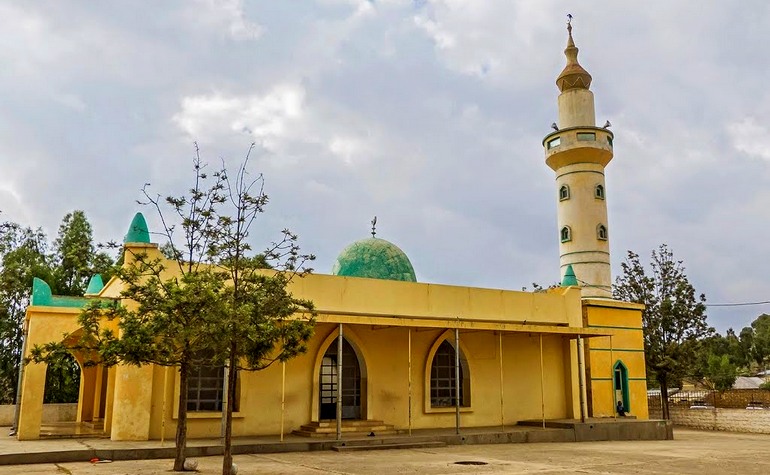
Najashi Mosque
The Negashi Mosque – Photo: hedgait.blogspot.co.uk
This masjid (mosque) is located in the town of Negash in northern Ethiopia and is around the area where a just ruler, Ashama ibn Abjar (King Negus) lived at the time of the Prophet (peace and blessings of Allah be on him). He gave refuge to two groups of Sahabah, companions of the Prophet (peace and blessings of Allah be on him) who migrated there on account of the persecution of the Quraysh in the early days of Islam.
  • After much suffering at the hands of the Quraysh in Makkah, the Prophet (peace and blessings of Allah be on him) commanded a small group of Muslims to make Hijrah (migration) to a safe place in the country of Abyssinia. (what is now Ethiopia). Abyssinia at that time was ruled by a Christian King (who later on embraced Islam), famous for his mercy and equity, whose title was Negus. They were sure to receive protection and worship and live in peace there.
  • In Rajab of the fifth year of the Mission (614-615 CE), the first group emigrated to Abyssinia. The group comprised about twelve men and five women and included Uthman (may Allah be pleased with him) and his wife Ruqayyah (may Allah be pleased with her), the daughter of the Prophet (peace and blessings of Allah be on him). The Quraysh pursued them to the port of Shuaibah by the Red Sea to capture them, but their vessels had left the shore. When the group reached Abyssinia, they heard the rumour that the whole tribe of the Quraysh had accepted Islam. They were naturally very much pleased at the news and returned to their country. On approaching Makkah, they learnt that the rumour was false and the persecutions were going on unabated. Some of them decided to return to Abyssinia and the rest entered Makkah, seeking the protection of a few influential people. This is known as the first migration to Abyssinia.
  • Later on, a bigger group of around 83 men and 18 women emigrated to Abyssinia led by Jafar bin Abu Talib (may Allah be pleased with him), the cousin of the Prophet (peace and blessings of Allah be on him). This is called the second emigration to that country and some Sahabah took part in both the migrations. The Qureysh did not like the emigrations, and the thought of peace enjoyed by the fugitives gave them no rest. They sent a delegation to Abyssinia led by Amr bin Aas (a non Muslim at the time) with handsome presents for the king, his courtiers and the clergy. The delegation first met the chiefs and the priests and, by offering them presents, succeeded in winning the court officials to their side.
  • When the king gave audience to the Quraysh, Amr bin Aas said that the Muslims in Abyssinia were not refugees from persecution but were fugitives from justice and law, and requested the king to extradite them to Makkah. The king, however, wanted to hear the other side of the story also before giving any judgment, and summoned Jafar (may Allah be pleased with him) to the court to answer the charges against the Muslims. Jafar (may Allah be pleased with him) made a memorable defence, addressing the Christian king he said,“O King! We were ignorant people and we lived like wild animals. The strong among us lived by preying upon the weak. We obeyed no law and we acknowledged no authority save that of brute force. We worshipped idols made of stone or wood, and we knew nothing of human dignity. And then God, in His Mercy, sent to us His Messenger who was himself one of us. We knew about his truthfulness and his integrity. His character was exemplary, and he was the most well-born of the Arabs. He invited us toward the worship of One God, and he forbade us to worship idols. He exhorted us to tell the truth, and to protect the weak, the poor, the humble, the widows and the orphans. He ordered us to show respect to women, and never to slander them. We obeyed him and followed his teachings. Most of the people in our country are still polytheists, and they resented our conversion to the new faith which is called Islam. They began to persecute us and it was in order to escape from persecution by them that we sought and found sanctuary in your kingdom.”
  • When Jafar (may Allah be pleased with him) concluded his speech, the king asked him, “Let us hear something of the Qur’an that your Prophet (peace and blessings of Allah be on him) has taught you.“ Jafar (may Allah be pleased with him) recited a few verses from the beginning of Surah ‘Maryam’, which touched the hearts of the king and the priestly class so much that tears flowed down their cheeks and wetted their beards. The king remarked, “By Allah, these words and the words revealed to Musa (upon him be peace) are the rays of one and the same light,” and he told the Quraysh embassy that he would by no means hand over the refugees to them. Then, disappointed and disgraced, they held a counsel. One of them said, “I have hit upon a plan that is sure to draw the king’s wrath upon their heads.“ Although the others did not agree to such a drastic step (for after all they were their own flesh and blood) he would not listen.
  • The next day, they excited the king by telling him that those heretics denounced Isa (upon him be peace) [Jesus] and did not believe in his Divinity. The Muslims were again summoned to the court. They were much more distressed this time. When the king inquired about their belief in Isa (upon him be peace), they said: “We believe in what Allah has revealed about him to our Prophet (peace and blessings of Allah be on him), i.e. he is a servant and Prophet of Allah, and is His word, which He conveyed to the virgin and pure Maryam.“ Negus said: “Isa (upon him be peace) himself does not say anything beyond that.“ The priests then began to murmur in protest, but the king would not listen to them. He returned to the delegation the presents they had brought for him, and said to the Muslims, “Go and live in peace. If anybody ill-treats you, he will have to pay heavily for it.“ A royal declaration was also issued to that effect. This enhanced the prestige of the Muslims in the country, and the Quraysh delegation had to return crestfallen.
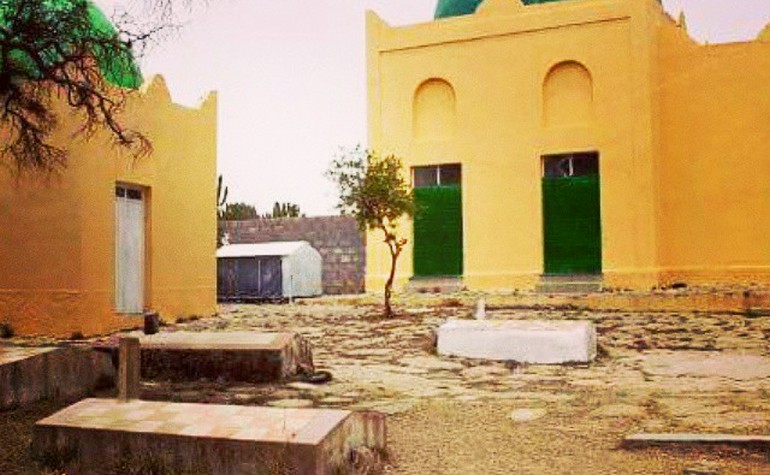
  • King Negus is buried within the masjid compound as are several Sahabah who died there. Negash is, therefore, not only the burial place of the world’s first Muslim king but also the resting place of the bodies of the early Muslims of the world who were denied a home to be buried in because of their beliefs.
  • The Muslims finally returned from Abyssinia in 7 A.H. but to Madinah and not Makkah.
The graveyard in the Negashi mosque compound
The graveyard in the Negashi mosque compound – Photo: diary_of_an_imam (Instagram)

References: Fazail-e-Aamal – Sheik Zakariyya Kandhalvi, Wikipedia, Tigray.net

Friday, December 26, 2014

Tomb of Umme Haram(may Allah be pleased with her)

This is the location (in Larnaca, Cyprus) of the tomb of Umme Haram (may Allah be pleased with her), who was the aunt of Anas (may Allah be pleased with him). The Prophet Muhammad (peace and blessings of Allah be on him) often visited her and sometimes had his afternoon nap at her place in Madinah.
The Prophet (peace and blessings of Allah be on him) was once sleeping in her house, when he woke up smiling.
Umme Haram (may Allah be pleased with her) said: “O Prophet! You are dearer to me than my parents, tell me what made you smile.”
He said: “I saw in my dream a few of my followers going for Jihad across the sea. They, in their barges, looked like kings sitting on their thrones.”
Umme Haram (may Allah be pleased with her) said: “O, Prophet of Allah! Pray that I may also be one among those people.”
He replied: “Rest assured, you will be one of them.”
He went to sleep again, and got up smiling for the second time. On Umme Haram’s query he said: “I again saw some more people going for Jihad across the sea.”
Umme Haram (may Allah be pleased with her) requested him to pray for her joining them also, he said: “No, you are with the first group only.”
During the Khilafat of Usman (may Allah be pleased with him), Amir Muawiyah (may Allah be pleased with him), the Governor of Syria, sought permission to send an expeditionary force to Cyprus Island. This permission was granted by Usman (may Allah be pleased with him). Umme Haram (may Allah be pleased with her), with her husband Ubadah bin Samit (may Allah be pleased with him) was in that force. While returning from the island she fell from her mule, broke her neck and died. She was buried in the above place.


References:ilmfeed.com/why-female-companion-prophet-buried-in-cyprus/ ( Photos ) , Fazail-e-Aamal – Sheikh Zakariyya
Kandhalvi
This is how the Ottoman-built mosque (known as
the Hala Sultan Tekke or the Mosque of Umm
Haram) looks like


A tomb has been built over the grave which is
located at the rear of the Mosque


Her blessed grave lies behind this gate. May Allah
be pleased with her.


Thursday, December 25, 2014

Mosque of Uqba-bin-Nafe(may Allah be pleased with him)


This mosque was built by the Sahabi, Uqba-bin-Nafe (may Allah be pleased with him) from 670 CE at the founding of the city of Kairouan in Tunisia.
  • Uqba-bin-Nafe (may Allah be pleased with him) was a military general who began the Islamic conquest of the Maghreb, including present-day western Algeria and Morocco in North Africa. He used Kairouan as a base to mount operations. The mosque became an important center for Islamic and Quranic learning, and attracted a large number of Muslims from various parts of the world. The mosque is spread over a surface area of 900 square meters and is considered as a model for all later mosques in the Maghreb in the western Islamic world.
  • Uqba-bin-Nafe (may Allah be pleased with him) was killed and buried near Biskra in Algeria.
References:  Wikipedia

Wednesday, December 24, 2014

Cathedral of Abraha, Yemen

Cathedral of Abraha

This walled enclosure in San’a, Yemen is where Abraha al-Ashra built an imposing cathedral. Abraha was a Christian ruler of Yemen who wanted to divert Arab pilgrimage from the Ka’bah to his cathedral. He set out with an army (which included elephants) to destroy the Ka’bah but was struck down on the outskirts of Makkah by a hail of stones carried by birds. The story is mentioned in Surah Feel in the Quran.

Source : www.islamiclandmarks.com

Tuesday, December 23, 2014

Tomb of Prophet Hud(upon him be peace)

This tomb, in Hadhramaut, Yemen belongs to Hud (upon him be peace) who was sent as a Prophet to the people of ‘Aad. The people of ‘Aad were known uniquely for their mighty strength and size. The majority however, rejected the invitation of Hud (upon him be peace) and were destroyed by a powerful wind. The eleventh Surah of the Holy Quran is named after Hud (upon him be peace).

Note that this entry has been shown for information purposes only. On no account should anybody pray towards a grave or seek supplication through them as this is tantamount to committing shirk, associating partners with Allah (Glorified and Exalted is He)


Reference: Stories of the Prophets – Ibn Kathir, theislamonline.com/2013/11/graves-of-prophets-of-allah-prophets-graves/, www.yementourism.com/tourism2009/interests/detail.php?IBLOCK_ID=104&SECTION_ID=294&ELEMENT_ID=2697

Monday, December 22, 2014

Mosque of Cordoba


The Mosque of Cordoba, in Andalucia, Spain was originally the site of a church which was bought by the Muslim Emir Abd ar-Rehman I and subsequently converted into one of the largest mosques in the world with work starting in 784 CE. Cordoba became one of the most advanced cities in the world, as well as a great cultural, political and economic centre and the mosque featured as a great centre of learning.
  • The building is most notable for its giant arches, with over 1,000 columns of jasper, onyx, marble, and granite; the double arches, which were a new architectural feature and the rich and exquisite design patterns making it one of the most beautiful mosques to have existed.
  • In 1236 CE, Cordoba was recaptured from the Muslims by King Ferdinand III and the mosque was reconsecrated as a Christian church, with the most significant alteration being the construction of a Renaissance cathedral nave in the middle of the structure (see above).

Reference:  Wikipedia

Sunday, December 21, 2014

Memorial to Imam Bukhari

This memorial complex, near Samarkand in
Uzbekistan houses the grave of Imam Bukhari,
most well known for authoring the hadith
(sayings of the Prophet) collection named Sahih
Bukhari, regarded as the most authentic of all
hadith compilations and the most authoritative
book after the Quran.
Imam Bukhari was born in 810 CE in the city of
Bukhara (in Uzbekistan). His full name was
Muhammad Ibn Ismail Ibn Ibrahim Ibn al-
Mughirah Ibn Bardizbah al-Bukhari. He had a
phenomenal memory and travelled throughout the
Islamic world devoting himself to the collection,
study, proof-reading and organizing of hadith.
Reference: Wikipedia , www.manzaratourism.com/uzbekistan/imam-al-bukhari-complex ( photo )

Saturday, December 20, 2014

Adam’s Peak - first foot mark on earth of HAZRAT ADAM( AS )

The alleged footprint of Prophet Adam (peace be upon him)
The alleged footprint of Prophet Adam (peace be upon him) – Photo: in-sri-lanka.ru
This footprint, measuring 5’7” by 2’6” is believed to be the footprint of the Prophet Adam (upon him be peace) who was said to be 60 cubits tall. It is located on the top of a mountain in Sri Lanka called Adam’s Peak (also known as Sri Pada – the Holy Footprint).
  • It is the opinion of some scholars that when Adam (upon him be peace) was taken out of paradise and placed in this world he landed in Sri Lanka. Buddhists believe the footprint to be that of Buddha and a place of worship (as shown above). Please note that this place has been shown for information purposes only; it is not a place of veneration for Muslims.
Adam's Peak - mountain top view
Mountain top view of Adam’s Peak – Photo: theholidayindia.com
  • Adam (upon him be peace) is mentioned by name 25 times in the Quran.
  • When he taken out of paradise and placed on earth, Prophet Adam (peace be upon him) cried a lot. Coincidentally, Sri Lanka resembles the shape of a tear drop.
Map of Sri Lanka
Map of Sri Lanka

References:Atlas of the Quran – Dr. Shauqi Abu Khalili, Geocities.com/islamimiracles4


Adam's Peak from a distance